Special Order - allow 2+ weeks lead
Couldn't load pickup availability
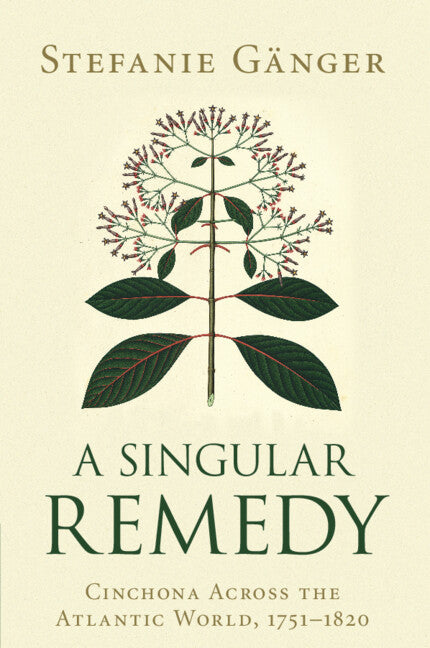
A Singular Remedy
Cinchona Across the Atlantic World, 1751–1820
Innovative exploration of how medical knowledge was shared between and across diverse societies tied to the Atlantic World around 1800.
Stefanie Gänger (Author)
9781108816335, Cambridge University Press
Paperback / softback, published 27 October 2022
256 pages
22.8 x 15 x 1.5 cm, 0.38 kg
'… an impressive addition to the historiography on the global circulation of medicinal substances and associated knowledge and practices. By breaking free of individual imperial contexts, Gänger has demonstrated both the commonalities of the experience of cinchona across the Atlantic world while also showing they interacted with local tastes and therapeutic practices. Her work deserves to be closely engaged with by medical historians and scholars of global circulation and trade, and will hopefully prompt further research into the early global history of cinchona as well as inter-regional movement of other medical commodities.' Katrina Maydom, Journal of the History of Biology
Stefanie Gänger explores how medical knowledge was shared across societies tied to the Atlantic World between 1751 and 1820. Centred on Peruvian bark or cinchona, Gänger shows how that remedy and knowledge about its consumption – formulae for bittersweet, 'aromatic' wines, narratives about its discovery or beliefs in its ability to prevent fevers – were understood by men and women in varied contexts. These included Peruvian academies and Scottish households, Louisiana plantations and Moroccan court pharmacies alike. This study in plant trade, therapeutic exchange, and epistemic brokerage shows how knowledge weaves itself into the fabric of everyday medical practice in different places.
Introduction. A singular remedy
I.1 The outlines of cinchona
I.2 An appraisal of the historiography
I.3 Book structure
1. Origin stories
1.1 Unalienable truths
1.2 Botanists by instinct
1.3 Illiterate saviours
2. The demands of humanity
2.1 World bark trade
2.2 Geographies of consumption
2.3 Limits to distribution
3. Community of practice
3.1 'Proper evacuations'
3.2 Preparations of the bark
3.3 Proprietary medicines
4. Febrile situations
4.1 Marshes and wetlands
4.2 Cities, ships and camps
4.3 'Hot climates'
5. Harvests of change
5.1 The growth regions
5.2 The spectre of extinction
5.3 The bark cutters
Conclusion. A plant of the world.
Subject Areas: History of science [PDX], History of medicine [MBX], Modern history to 20th century: c 1700 to c 1900 [HBLL]