Freshly Printed - allow 7 days lead
Couldn't load pickup availability
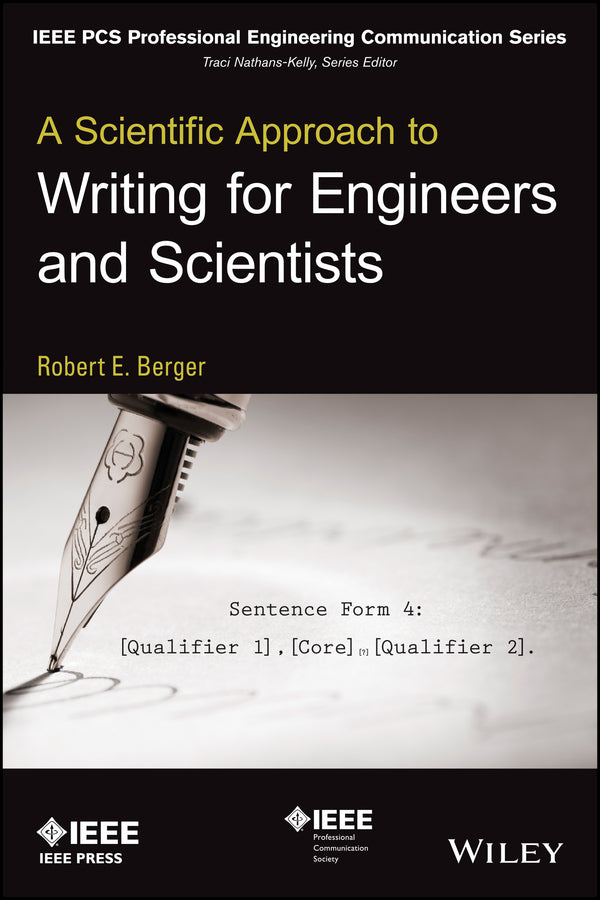
A Scientific Approach to Writing for Engineers and Scientists
Robert E. Berger (Author)
9781118832523, Wiley
Paperback / softback, published 17 June 2014
246 pages
23.1 x 15.8 x 1.3 cm, 0.358 kg
A SCIENTIFIC APPROACH TO WRITING Technical ideas may be solid or even groundbreaking, but if these ideas cannot be clearly communicated, reviewers of technical documents—e.g., proposals for research funding, articles submitted to scientific journals, and business plans to commercialize technology—are likely to reject the argument for advancing these ideas. The problem is that many engineers and scientists, entirely comfortable with the logic and principles of mathematics and science, treat writing as if it possesses none of these attributes. The absence of a systematic framework for writing often results in sentences that are difficult to follow or arguments that leave reviewers scratching their heads. This book fixes that problem by presenting a “scientific” approach to writing that mirrors the sensibilities of scientists and engineers, an approach based on an easily-discernable set of principles. Rather than merely stating rules for English grammar and composition, this book explains the reasons behind these rules and shows that good reasons can guide every writing decision. This resource is also well suited for the growing number of scientists and engineers in the U.S. and elsewhere who speak English as a second language, as well as for anyone else who just wants to be understood.
A Note from the Series Editor, xiii Acknowledgments, xv Foreword, xvii Preface, xxi 1 Introduction to the Approach 1 PART I Sentences 9 2 Qualifiers Used in Sentences 11 3 Subordinate Clauses Used as Qualifiers 21 4 Explanatory Phrases, Participle Phrases, and Major Prepositional Phrases 31 5 Infinitive Phrases, and the General Rule for Punctuating Qualifiers 45 6 Sentences with Two Qualifiers 55 7 Higher Orders of Punctuation 69 8 Strategies to Improve Sentences with Qualifiers 77 PART II Lists 89 9 Two-Item Lists 91 10 Multiple-Item Lists 103 11 Strategies for Writing Better Lists 111 PART III Word Choice and Placement 119 12 Adjectives and Adverbs 121 13 Precision in Word Usage 135 PART IV Beyond Sentences 149 14 Paragraphs 151 15 Arguments 163 16 Justification of Arguments 173 17 Organization and Presentation 181 References, 193 About the Author, 207 Index, 209
Subject Areas: Electronics & communications engineering [TJ]