Freshly Printed - allow 10 days lead
Couldn't load pickup availability
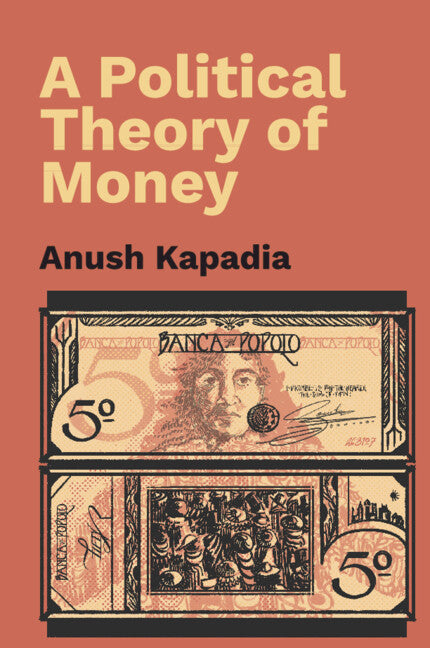
A Political Theory of Money
Understanding money's nature as political, institutional, and material answers today's big money questions.
Anush Kapadia (Author)
9781009331432, Cambridge University Press
Hardback, published 4 January 2024
272 pages
23.6 x 15.8 x 2.2 cm, 0.49 kg
Understanding money's nature as political, institutional, and material answers today's big money questions. Money remains a foundational question of social theory. What is money? Why does something so insubstantial have value? How do money systems make promises function like valuable things? Why are money systems always hierarchical yet variable? The answer, the book argues, is politics. Money is institutionalised social power. Politics generates institutions that differentially lock into the future product of political and economic collectives. Money emerges from the institutionalisation of social antagonisms to encapsulate a collective's productive potential in a flexible, tradable instrument. This takes a system. Money is built in hierarchical layers out of the inherently variable material of politics and at various economic scales. This book outlines these variable processes theoretically and through case studies.
Acknowledgements
Part I. 1. Money anchored to the future
2. The money fetish: making promises into things
3. Bending not breaking: monetary sovereignty and the survival constraint
4. Mystical kernel within the rational shell: the Banking School's residual Chartalism
5. Between currency and credit: Mehrling's money view
6. There is no such thing as fiat money
7. Coherence: why money is not value
Part II. 8. National Money vs Shadow Banking: contradictions of a public-private credit system
9. A world without world money
10. Proof of institutions: cryptocurrencies as digital fiat money
11. Europe and democratic funding
12. Democratic sovereignty makes money
References
Index.
Subject Areas: Economic & financial crises & disasters [KCX], Economic systems & structures [KCS], Political economy [KCP], Monetary economics [KCBM]