Freshly Printed - allow 10 days lead
Couldn't load pickup availability
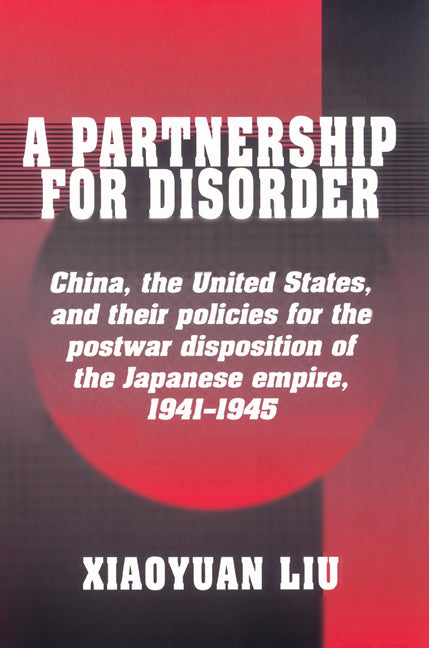
A Partnership for Disorder
China, the United States, and their Policies for the Postwar Disposition of the Japanese Empire, 1941–1945
This study unravels some of the complex origins of the postwar upheavals in Asia.
Xiaoyuan Liu (Author)
9780521528559, Cambridge University Press
Paperback / softback, published 25 July 2002
364 pages, 1 map
23 x 15.4 x 2.3 cm, 0.66 kg
'Liu has produced a lucid account based on a wide range of Chinese and American sources.' English Historical Review
A Partnership for Disorder examines American-Chinese foreign policy planning in World War II for decolonising the Japanese Empire and controlling Japan after the war. This study unravels some of the complex origins of the postwar upheavals in Asia by demonstrating how the US and China's disagreements on many concrete issues prevented their governments from forging an effective partnership. The two powers' quest for long-term cooperation was further complicated by Moscow's eleventh-hour involvement in the Pacific War. By the war's end, a triangular relationship among Washington, Moscow, and Chongqing surfaced from secret negotiations at Yalta and Moscow. Yet the Yalta-Moscow system in Asia proved too ambiguous and fragile to be useful even for the purpose of defining a new balance of power among the Allies. The failure of the system was compounded by its obliviousness to Asia's dynamic nationalist forces.
Acknowledgments
Note on romanization
Abbreviations
Introduction
1. The making of an alliance
2. The issue of postwar Japan
3. China's lost territories
4. Korea's independence
5. The road to Cairo
6. A divisive summit
7. Yan'an and postwar East Asia
8. Diplomacy without action
9. Erosion of a partnership
10. The Manchurian triangle
11. Bargaining at Moscow
12. Epilogue: the crisis of peace
Appendices
Bibliography
Index.
Subject Areas: Second World War [HBWQ], General & world history [HBG]