Freshly Printed - allow 6 days lead
Couldn't load pickup availability
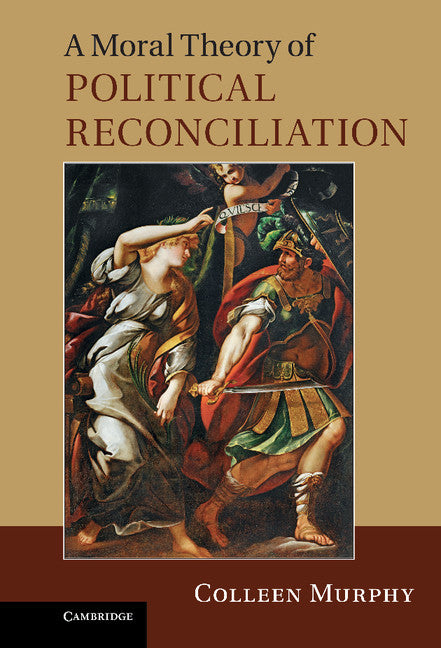
A Moral Theory of Political Reconciliation
This book discusses the difficulties arising from civil conflict and repression, and how to proceed in repairing political relationships within transitional societies.
Colleen Murphy (Author)
9780521193924, Cambridge University Press
Hardback, published 7 October 2010
224 pages
22.9 x 15.2 x 1.4 cm, 0.47 kg
Review of the hardback: 'A Moral Theory of Political Reconciliation is far and away the best treatment of political reconciliation in a growing literature on this hot topic. Murphy has mastered this literature, distilled it, and set it off against her own views, which, to my mind, are better than the extant views. I would single out her discussion of the concepts of reconciliation, rule of law, and trust, as especially meritorious; I learned an enormous amount from them. The book is a tour-de-force, setting out a new way to think of reconciliation and arguing at length against all of the major alternative approaches.' Larry May, Vanderbilt University
Following extended periods of conflict or repression, political reconciliation is indispensable to the establishment or restoration of democratic relationships and critical to the pursuit of peacemaking globally. In this book, Colleen Murphy offers an innovative analysis of the moral problems plaguing political relationships under the strain of civil conflict and repression. Focusing on the unique moral damage that attends the deterioration of political relationships, Murphy identifies the precise kinds of repair and transformation that processes of political reconciliation ought to promote. Building on this analysis, she proposes a normative model of political relationships. A Moral Theory of Political Reconciliation delivers an original account of the failure and restoration of political relationships, which will be of interest to philosophers, social scientists, legal scholars, policy analysts, and all those who are interested in transitional justice, global politics, and democracy.
Acknowledgements
Introduction
Part I. Conceptual Frameworks: 1. The rule of law
2. Political trust
3. Capabilities
Part II. Promoting Political Reconciliation: 4. Evaluating processes of political reconciliation
5. Truth commissions
6. International criminal trials
Conclusion
Bibliography.
Subject Areas: Society & social sciences [J], Social & political philosophy [HPS]