Freshly Printed - allow 10 days lead
Couldn't load pickup availability
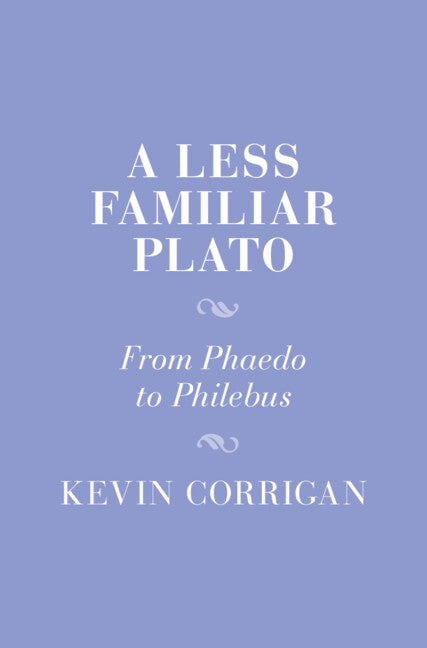
A Less Familiar Plato
From Phaedo to Philebus
Provides new views of perception; embodiment; the Good/Forms; art, imagination, and the divine; interdialogue connections and unwritten teachings
Kevin Corrigan (Author)
9781009324854, Cambridge University Press
Hardback, published 9 November 2023
352 pages
23.5 x 15.8 x 2.8 cm, 0.67 kg
'… this original and wide-ranging book deserves and rewards careful engagement.' John D. Proios, Bryn Mawr Classical Review
In this book, Kevin Corrigan sheds light on aspects of Plato's thought that are less familiar to contemporary readers. He reveals a Plato who believes in Forms but is not essentialist, who develops a scientific view of perception in the middle and late dialogues, and who offers positive models of art and science. Corrigan shows how Plato articulates a broader view of intelligible reality in which embodiment is affirmative and the mind-soul-body continuum has an eidetic structure, and where even failure and the imperfect are included. He also demonstrates that Plato developed an ideal, yet finely layered view of love that provided a practical guide throughout antiquity; and that the dialogues and unwritten teachings can be understood in a mutually open-ended, non-antagonistic way. Corrigan's book provides a guide to Plato in an unexpected key and poses important questions regarding imagination, divine inspiration, and Forms and the Good, among other topics.
I. Embodiment and Participation in the Divine: 1. The Phaedo: embodiment, disembodiment, and the question of 'self'
2. The place and scope of participation in the divine in Plato and Aristotle
II. Introduction to the Republic and Philebus, Chapters 4-6: 3. The Training of perception: views of Art in the Republic and other works
4. The non-hypothetical good: art, mind, imagination in the Republic
5. Is the idea of the good beyond being?
6. The Philebus-to Stand in the porches of the good and the dwelling of the such
III. Introduction to Love, Myth, Erotikē Technē, and Generative Epistēmē (Chapters 7-9): 7. Love and myth: Symposium, Republic, and Phaedrus
8. Desire, love, and friendship: a reading of the Lysis, Alcibiades I, Symposium, and Phaedrus
9. The many questions of Plato's Phaedrus: did Plato write a commentary on his own work? 10. General conclusion
Appendix: scientific perception or sharp seeing in the middle and late dialogues.
Subject Areas: History of ideas [JFCX], Theology [HRLB], Philosophy of religion [HRAB], Western philosophy: Ancient, to c 500 [HPCA], Classical history / classical civilisation [HBLA1]