Freshly Printed - allow 7 days lead
Couldn't load pickup availability
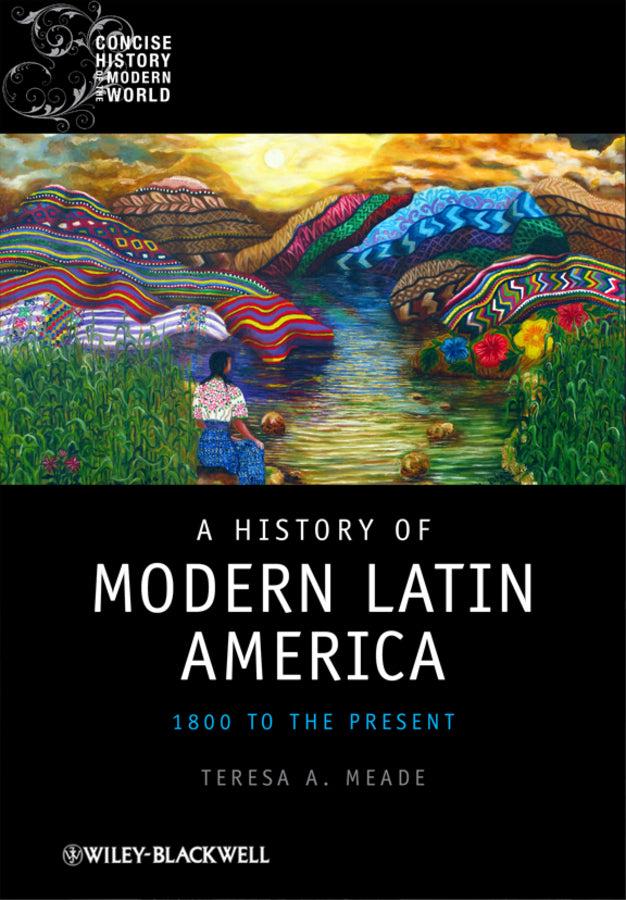
A History of Modern Latin America
1800 to the Present
“Nothing is more important than to communicate up-to-date scholarship to students in a lucid and reasonable manner. It seems to me that [this] textbook is remarkably successful in both these respects." (British historian, Eric J Hobsbawn, 1 October 2012)
"Teresa Meade’s A History of Modern Latin America brings a new approach to introducing students to the region. Using exciting themes like class, gender and ethnicity, she compares and contrasts places and peoples, some well known and others less familiar. In doing so Meade makes connections between events that are often ignored, showing readers that history is not simply hero worship and that historians are not simply document readers."
Jeffrey Lesser, Emory University
"Clearly written, conceptually accessible, comprehensive, and broad in scope, Teresa Meade’s text is an excellent alternative for survey courses on Latin America. Meade both reflects recent conceptual innovations in the field, and provides a consistent and comprehensive narrative and periodization. Not only will this text provide a reliable guide for undergraduates, but professors will also find themselves stimulated to rethink their own assumptions about the main issues in the field. I heartily recommend it."
Florencia E. Mallon, Julieta Kirkwood Professor of History, University of Wisconsin-Madison
"This is the rare history of modern Latin America that does justice to the crucial political and economic trends of the last two centuries while exploring in-depth the social and cultural aspects of Latin American societies."
Barbara Weinstein, New York University
Teresa A. Meade (Author)
9781405120500, Wiley
Hardback, published 27 November 2009
416 pages
25.4 x 17.8 x 2.8 cm, 0.88 kg
A History of Modern Latin America: 1800 to the Present examines the diverse and interlocking experiences of people of indigenous, African, and European backgrounds from the onset of independence until today. Student and instructor resources available at http://minerva.union.edu/meadet/modernlatinamerica/index.html [Wiley disclaims all responsibility and liability for the content of any third-party websites that can be linked to from this website. Users assume sole responsibility for accessing third-party websites and the use of any content appearing on such websites. Any views expressed in such websites are the views of the authors of the content appearing on those websites and not the views of Wiley or its affiliates, nor do they in any way represent an endorsement by Wiley or its affiliates.]
List of Figures xi List of Maps xiii Preface xiv Acknowledgments xvii Cover image xix 1 Introduction to the Land and Its People 1 Geography 2 People 2 Economies 6 Politics 8 Culture and Entertainment 12 Latin America: Past and Present 20 2 Latin America in 1790 23 Colonial Background 24 Power and Privilege 28 Land 29 Colonial Administration 32 Enlightened Monarchy 33 The Agents of the Reform 35 Disorder and Rebellion 37 Discontent and Disorder in Brazil 39 Changing Gender Roles 40 On the Road to Independence 42 Nationalism and American Culture 42 Conclusion 46 3 Competing Notions of Freedom 49 Five Roads to Independence 50 African Slavery in the Americas 51 Slavery and the Countryside 55 Slavery in the Cities 55 Treatment and Punishment 57 Slavery and the Church 58 African Medicine and Religious Practices 59 Resistance and Rebellion 60 The Sugar Colony of Saint-Domingue 62 The Slave Revolt 64 The Revolution Betrayed 66 Brazil’s Independent Empire 67 Independence in Mexico 68 South American Independence 70 Post-independence Changes in Racial and Gender Status 74 The Last Holdout of Slavery in Spanish America 75 Latin America in a Changing World Order 77 Conclusion 78 4 Fragmented Nationalisms 81 Searching for Political and Economic Unity 81 New World “Feudalism” 82 Post-independence Politics 86 Argentina and the Tyrants 87 Populist Caudillismo: Paraguay and Bolivia 89 After Caudillismo 91 Race, Race Mixture, and Liberalism 93 Gender and Liberalism 96 Intersections of Gender, Race, and Class 98 Nationalism 101 Conclusion 101 5 Latin America’s Place in the Commodity Chain 105 The Guano Boom 106 Nitrates in Chile 108 Sugar and Coffee 109 The Growth of São Paulo 111 Colombian Coffee 113 The Rubber Boom 114 Expanding Exports 115 Mexico and US Expansionism 117 The North American Invasion 118 General López de Santa Anna 120 The New Age of Imperialism 121 Central America and the Panama Canal 122 Ecuador and the “Panama” Hat 125 Independence at Last? Cuba and Puerto Rico 128 Conclusion 133 6 Immigration, and Urban and Rural Life 135 Asian Immigration 136 European Immigration 137 The Southern Cone 138 Life on the Pampas 141 British Investment 142 The Changing Cultural Landscape 144 Urban Renewal 147 Mexico and Benito Juárez 149 French Invasions 150 The Rise of Porfirio Díaz 151 Intellectual Theories: Positivism and Eugenics 152 Conclusion 154 7 Revolution from Countryside to City: Mexico 157 The Porfiriato 158 Opposition to the Porfiriato 160 Constitutional Opposition 161 Madero Assassinated 163 US Intervention 163 Women in Combat 164 Carranza as President 165 The Constitution of 1917 169 Aftermath of Struggle 170 Agrarian Revolts in Latin America 171 Conclusion 174 8 The Left and the Socialist Alternative 175 Socialism on the World Stage 175 Social Reform and the Middle Class 176 Anarchism, Socialism, and Anarcho-syndicalism 177 Women in the Workforce 178 Colombia: Resistance to the United Fruit Company 179 The Labor Movement 181 Socialism and the Arts 182 Tenentes Revolt and Brazilian Communism 183 Modern Art Week in Brazil 185 Women in the Arts 187 Socialism vs. Capitalism 189 José Carlos Mariátegui 190 Conclusion 191 9 Populism and the Struggle for Change 193 Getúlio Vargas and “New State” Politics 195 Juan Perón and Peronism 197 Perón’s Fall from Grace 200 Politics Engendered 201 Revolutionizing Mexico: Lázaro Cárdenas 203 Populism in Colombia and Peru 204 Central America 206 The Long Twentieth Century 210 Conclusion 211 10 Post-World War II Struggles for Sovereignty 213 World War II 213 Temporary Worker Program 215 Post-war Latin America 217 Military vs. Civilian Rule 219 The Absolute Dictator: Rafael Trujillo 221 Americas in Transition: Guatemala and Bolivia 225 Guatemala 225 Revolution in Bolivia 227 Mining and the Voice of Bolivian Activism 229 The Revolution in Decline 231 Conclusion 232 11 Cuba: Guerrillas Take Power 235 “History Will Absolve Me” 236 Causes for Discontent 237 The Revolutionary War 238 The Special Period in Peacetime 241 Cuba and the World 242 Ernesto “Che” Guevara 243 What Difference Did the Revolution Make? 246 Democratic Shortcomings 248 Conclusion 249 12 Progress and Reaction 251 Modernization and Progress 251 Brazil’s Military Coup 252 The National Security State 254 Latin America’s Youth Movement 255 Mexico 255 The Massacre at Tlateloco 256 The Chilean Road to Socialism 257 The Chilean Road to Socialism Dead Ends 259 Urban Guerrilla Warfare: Uruguay 260 Urban Guerrilla Warfare: Argentina 262 Dictatorship and State Terror 264 Mothers of the Plaza de Mayo 266 The War of the Malvinas/Falkland Islands 267 Movements for Revolutionary Change: Peru 269 Sendero Luminoso, the Shining Path 270 Women and Shining Path 272 Repression and Fujimori 273 Conclusion 274 13 Revolution and Its Alternatives 277 A Changing Catholic Church 278 Marxism and Catholic Humanism 279 The Opposition 281 The Somozas versus Sandino: the Next Generation 281 The Sandinista Opposition 282 Sandinistas in Power 285 United States and the Sandinistas 288 Effects of the Contra War 289 Central America in Turmoil: El Salvador and Guatemala 291 Politics of Repression in El Salvador 292 The Opposition 293 The Fighting Ends 294 Guatemala: The Bloodiest War 295 The Evangelical Alternative 297 Colombia: The Longest War 299 The War on Drugs in Latin America 300 Conclusion 303 14 The Americas in the Twenty-first Century 305 The Washington Consensus 305 Brazil and the Workers’ Alternative 306 The Workers’ Party in Power 308 Bolivia: Twenty-first-century Indigenismo 309 Venezuela and Hugo Chávez 310 The Bolivarian Mission 312 Chávez and “the Pink Tide” 313 Complicating Social Ties 314 Chile’s Transition to Democracy 315 New Social Movements 317 Movements for Racial and Gender Equality 319 Women and Politics 320 The Latin Americanization of the United States 322 Immigration and Free Trade 325 Opponents Confront Free Trade 327 Immigration and Neoliberalism 330 Sharing the Environment and the Cost of Stewardship 331 Notes 335 Glossary 341 Further Reading 345 Index 359
Subject Areas: History [HB]