Freshly Printed - allow 8 days lead
Couldn't load pickup availability
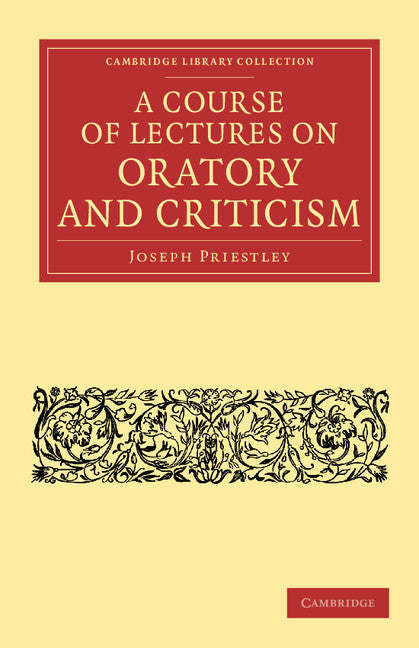
A Course of Lectures on Oratory and Criticism
Priestley integrates classical rhetorical principles with contemporary theories of mind in this lecture series, reissued here in its 1781 printing.
Joseph Priestley (Author)
9781108066075, Cambridge University Press
Paperback / softback, published 24 October 2013
396 pages
21.6 x 14 x 2.2 cm, 0.5 kg
While a tutor at Warrington Academy, the polymath Joseph Priestley (1733–1804) established himself as a leading grammarian and educational theorist, producing the influential Rudiments of English Grammar (1761) and A Course of Lectures on the Theory of Language and Universal Grammar (1762), both of which are reissued in this series. In 1762 he also delivered these lectures on rhetorical theory, arguing that the purpose of rhetoric is moral formation. Priestley was deeply influenced by associationism, a theory of mind developed by John Locke and David Hartley. This claims that all complex ideas develop from simple ones, which arise purely from sensory impressions. The orator's role, then, is to form the right associations between impressions and ideas in a listener's mind. Informed by this theory, these thirty-five lectures re-evaluate the classical rhetorical components of topic, method and style. First published in 1777, the work is reissued here in its 1781 Dublin printing.
Dedication
Preface
Part I: 1. The introduction
2. Of the nature and use of topics
3. Of universal topics
4. Of particular topics
5. Of amplification
Part II: 6. Of method in narrative discourses
7. Of method in argumentative discourses
8. Of the several parts of a proper demonstration
9. Of the analytical method
10. Of the method of Mr Hume's inquiry into the principles of morals, etc.
Part III: 11. Of taste
12. What affects the passions, judgment, and imagination
13. Of the tendency of strong emotions to produce belief
14. Of the influence of the passions on each other
15. Of forms of address adapted to gain belief
16. Of objections, etc.
17. Of the pleasures of imagination
18. A general account of the pleasure we receive from objects
19. Of novelty
20. Of the sublime
21. Of the pleasure we receive from uniformity, and variety
22. Of the nature of metaphors
23. Rules for the use of metaphors
24. Of contrast
25. Of burlesque etc.
26. Of riddles, puns, etc.
27. Of metoymy
28. Of the hyperbole and bombast
29. Of personification
30. Of imitation
31. Of climax
32. Of perspicuity in style
33. Of the resemblance between sound and sense
34. Of harmony in verse
35. Of harmony in prose.
Subject Areas: Semantics, discourse analysis, etc [CFG]