Freshly Printed - allow 7 days lead
Couldn't load pickup availability
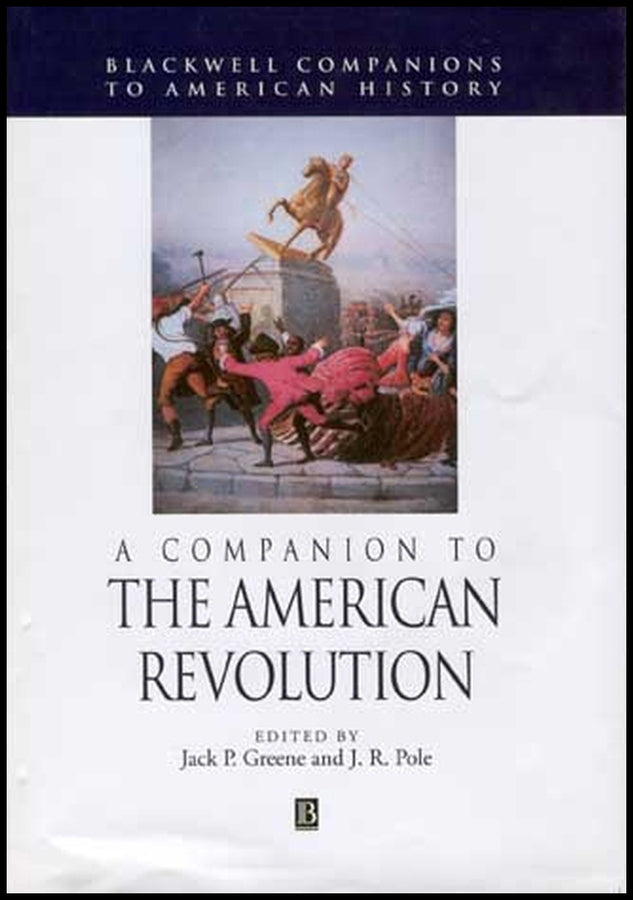
A Companion to the American Revolution
Jack P. Greene (Edited by), J. R. Pole (Edited by)
9780631210580, Wiley
Hardback, published 14 January 2000
796 pages
25.4 x 18.3 x 4.5 cm, 1.479 kg
"Professors Greene and Pole have succeeded in gathering a star-studded cast of scholars to interpret and analyze the American Revolution. General readers as well as teachers will find this volume of inestimable value." Joyce Appleby, University of California at Los Angeles "This immensely helpful guide will be useful for seasoned students of the revolution as well as beginners. Brief bibliographies give quick access to the best current work; the essays provide relevant factual material; and the reader gets the informed judgment of an expert." Richard Lyman Bushman, Columbia University "The cumulative effect of the contributions is to leave the reader with no doubt of the importance of the American Revolution, not just to the history of the United States and North America, but to the whole Atlantic world and beyond." History
A Companion to the American Revolution is a single guide to the themes, events, and concepts of this major turning point in early American history. Containing coverage before, during, and after the war, as well as the effect of the revolution on a global scale, this major reference to the period is ideal for any student, scholar, or general reader seeking a complete reference to the field.
List of maps and map acknowledgements x List of contributors xi Introduction xiii PART I: CONTEXT 1 01 The structure of British politics in the mid-eighteenth century 3 02 Metropolitan administration of the colonies, 1696–1775 8 03 Intra-imperial communications, 1689–1775 14 04 The changing socio-economic and strategic importance of the colonies to the empire 19 05 The political development of the colonies after the Glorious Revolution 29 06 Population and family in early America 39 07 Socio-economic development of the colonies 51 08 Religion before the Revolution 60 09 The cultural development of the colonies 65 10 The emergence of civic culture in the colonies to about 1770 82 11 Ideological background 88 12 The Amerindian population in 1763 94 PART II: THEMES AND EVENTS, TO 1776 99 13 The origins of the new colonial policy, 1748–1763 101 14 The Seven Years’ War and its political legacy 112 15 The Grenville program, 1763–1765 118 16 The Stamp Act crisis and its repercussions, including the Quartering Act controversy 123 17 The Townshend Acts crisis, 1767–1770 134 18 The British Army in America, before 1775 151 19 The West and the Amerindians, 1756–1776 157 20 Trade legislation and its enforcement, 1748–1776 165 21 Ongoing disputes over the prerogative, 1763–1776 173 22 Bishops and other ecclesiastical issues, to 1776 179 23 Social protest and the revolutionary movement, 1765–1776 184 24 The tea crisis and its consequences, through 1775 195 25 The crisis of Independence 206 26 Development of a revolutionary organization, 1765–1775 216 27 Political mobilization, 1765–1776 222 28 Identity and Independence 230 29 Loyalism and neutrality 235 30 Opposition in Britain 248 31 Common Sense 254 32 The Declaration of Independence 258 PART III: THEMES AND EVENTS, FROM 1776 263 33 Bills of rights and the first ten amendments to the Constitution 265 34 State constitution-making, through 1781 269 35 The Articles of Confederation, 1775–1783 281 36 The War for Independence, to Saratoga 287 37 The War for Independence, after Saratoga 298 38 The Continental Army 308 39 Militia, guerrilla warfare, tactics, and weaponry 314 40 Naval operations during the War for Independence 320 41 The First United States Navy 326 42 The home front during the War for Independence: the effect of labor shortages on commercial production in the Mid-Atlantic 332 43 Resistance to the American Revolution 342 44 Diplomacy of the Revolution, to 1783 352 45 Confederation: state governments and their problems 362 46 The West: territory, states, and confederation 374 47 Demobilization and national defense 383 48 Currency, taxation, and finance, 1775–1787 388 49 Foreign relations, after 1783 398 50 Slavery and anti-slavery 402 51 Amerindians and the new republic 413 52 The impact of the Revolution on the role, status, and experience of women 419 53 The impact of the Revolution on education 427 54 The impact of the Revolution on social problems: poverty, insanity, and crime 435 55 The impact of the Revolution on church and state 444 56 Law: continuity and reform 452 57 Confederation: movement for a stronger union 458 58 The Federal Convention and the Constitution 470 59 The debate over ratification of the Constitution 482 PART IV: EXTERNAL EFFECTS OF THE REVOLUTION 495 60 Great Britain in the aftermath of the American Revolution 497 61 The American Revolution in Canada 503 62 The American Revolution and Ireland 511 63 The American Revolution and the sugar colonies, 1775–1783 515 64 The effects of the American Revolution on France and its empire 523 65 The impact of the American Revolution on Spain and Portugal and their empires 531 66 The influence of the American Revolution in the Netherlands 545 67 The influence of the American Revolution in Germany 550 68 The influence of the American Revolution in Russia 554 PART V: INTERNAL DEVELOPMENTS AFTER THE REVOLUTION 557 69 The economic and demographic consequences of the American Revolution 559 70 The religious consequences of the Revolution 579 71 The cultural effects of the Revolution 586 72 The effects of the Revolution on language 595 73 Medicine before and after the Revolution 600 74 The construction of gender in a republican world 605 75 The construction of race in republican America 610 76 The construction of social status in revolutionary America 617 PART VI: CONCEPTS 625 77 Liberty 627 78 Equality 633 79 Property 638 80 The rule of law 645 81 Consent 650 82 Happiness 655 83 Suffrage and representation 661 84 Republicanism 668 85 Sovereignty 674 86 Nationality and citizenship 680 87 The separation of powers 686 88 Rights 691 89 Virtue 696 90 Interests 701 Chronology 707 Index 745
W. A. Speck
Ian K. Steele
Richard R. Johnson
Alison G. Olson
Alan Tully
Robert V. Wells
Edwin J. Perkins
Edwin S. Gaustad
Michal J. Rozbicki
David Shields
Isaac Kramnick
Eric Hinderaker
Jack P. Greene
Thomas L. Purvis
Peter D. G. Thomas
Peter D. G. Thomas
Robert J. Chaffin
Douglas Edward Leach
Peter Marshall
R. C. Simmons
Jack P. Greene
Frederick V. Mills, Sr.
Edward Countryman
David L. Ammerman
David L. Ammerman
David W. Conroy
Rebecca Starr
Jack P. Greene
Robert M. Calhoon
Colin Bonwick
Jack Fruchtman, Jr.
Ronald Hamowy
Robert A. Rutland
Donald S. Lutz
Jack N. Rakove
Don Higginbotham
Don Higginbotham
Holly A. Mayer
Mark V. Kwasny
Clark G. Reynolds
James C. Bradford
Michael V. Kennedy
Michael A. McDonnell
Jonathan R. Dull
Edward Countryman
Peter S. Onuf
E. Wayne Carp
Robert A. Becker
Jonathan R. Dull
Sylvia R. Frey
James H. Merrell
Betty Wood
Melvin Yazawa
Melvin Yazawa
Robert M. Calhoon
J. R. Pole
Mark D. Kaplanoff
Mark D. Kaplanoff
Murray Dry
Ian R. Christie
Elizabeth Mancke
Maurice J. Bric
Selwyn H. H. Carrington
David P. Geggus
Kenneth Maxwell
Jan Willem Schulte Nordholt and Wim Klooster
Horst Dippel
Hans Rogger
Mary M. Schweitzer
Robert M. Calhoon
Norman S. Grabo
John Algeo
Mary E. Fissell
Ruth H. Bloch
James Sidbury
Christine Daniels
Elise Marienstras
J. R. Pole
Alan Freeman and Elizabeth Mensch
John P. Reid
Donald S. Lutz
Jan Lewis
Rosemarie Zagarri
Robert E. Shalhope
Peter S. Onuf
Elise Marienstras
Maurice J. C. Vile
Michael Zuckert
James T. Kloppenberg
Cathy Matson
compiled by Steven J. Sarson
Subject Areas: History [HB]