Freshly Printed - allow 7 days lead
Couldn't load pickup availability
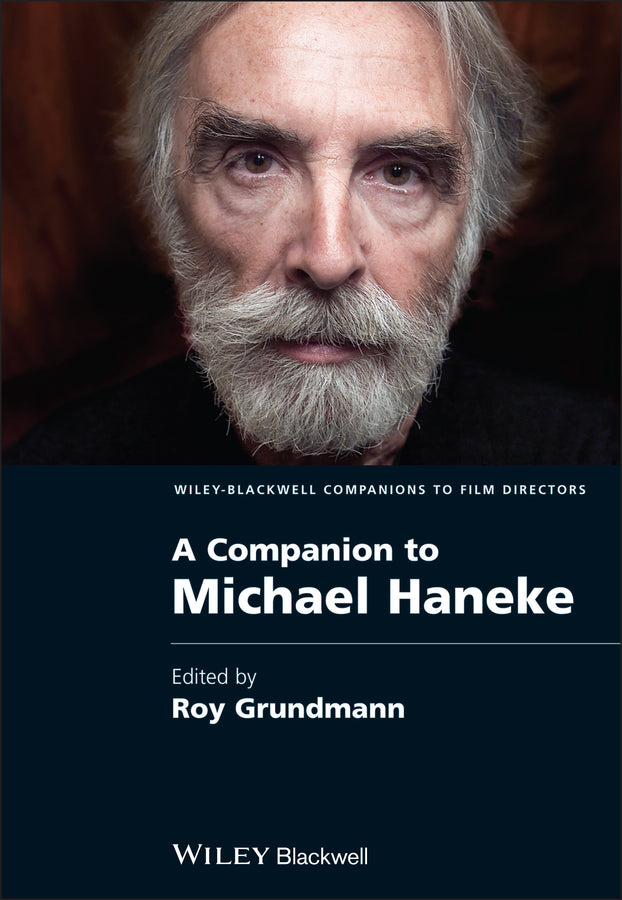
A Companion to Michael Haneke
"A Companion to Michael Haneke represents a major contribution to Haneke studies. It includes essays by leading film scholars on the German and French language films, and essays on Haneke’s newly available Television work of the seventies and eighties. Grundmann’s introductory survey (Haneke’s Anachronism”) will prove definitive in the field." Kirsten Thompson, Wayne State University "Forcefully tackling Haneke’s moral and philosophical games, stylistic rigor, and critical success, the first-rate scholars of this volume shed definitive light on the art film and television works of Europe’s most fashionably retró director. This is post-auteurism at its best." Giorgio Bertellini, University of Michigan "This collection’s range of essays offers a comprehensive account of Haneke’s work in film and television, as well as a number of strikingly original critical interventions. Its coverage of Haneke’s television feature films is particularly thorough and will initiate many Anglo-American readers into this body of work. Haneke is surely one of the most important contemporary artists working in any medium. This book is both a testimony to and a testing of his achievement." John David Rhodes, editor of On Michael Haneke (Wayne State University Press, 2010) and author of Stupendous, Miserable City: Pasolini's Rome (University of Minnesota Press, 2007) "Vacant since the deaths of Fassbinder, Truffaut, Tarkovsky and Bergman, the throne of European cinema is now claimed by Michael Haneke. A seasoned festival favourite, this master of transnational filmmaking would not stop astounding audiences with his thought-provoking close-ups of families, nations, and hushed histories. Roy Grundmann masterfully orchestrates this truly diverse assembly of insightful and up-to-date scholarship on Haneke. The volume not only brings together more than thirty scholars based in the US, Canada, France, Germany, Austria and elsewhere, but also unites generations, from senior scholars to PhD students, for a uniquely interdisciplinary project." Dina Iordanova, Publisher, The Film Festival Yearbook, http://www.dinaview.com/">www.DinaView.com, University of St. Andrews
Roy Grundmann (Edited by)
9781405188005, Wiley
Hardback, published 13 April 2010
656 pages
25.4 x 18 x 5.8 cm, 1.27 kg
“This makes the arrival of A Companion to Michael Haneke all the more welcome—for supporters like me, who will find ample evidence of Haneke’s intelligence and enterprise, and for open-minded skeptics willing to risk a change of heart by perusing the largest body of critical, theoretical, and historical work on Haneke so far assembled in one volume. The book’s thirty-two essays have been judiciously chosen and edited by Roy Grundmann, a firstrate scholar of against-the-grain cinema...This gives some idea of the breadth, creativity, and intelligence that distinguish this fine collection of essays on a filmmaker I still stand by as one of the most artfully audacious of our day.” (Film Quarterly, 1 April 2012)
A Companion to Michael Haneke With a new preface addressing the Academy award-winning film, Amour, this new-in-paper edition has established itself as the definitive collection on Michael Haneke—from his early work in television and theater, through his prodigious cinematic output, to his 2009 triumph at Cannes. A Companion to Michael Haneke brings together essays by leading film scholars, as well as interviews with the director himself, to probe the provocative and controversial themes that have formed the nucleus of Haneke’s work—intergenerational dysfunction and social alienation, colonialism and citizenship, surveillance and pornography, mass culture and media violence. The volume also offers a critical examination of the auteur’s oeuvre, including Three Paths to the Lake, Lemmings, Benny’s Video, The Piano Teacher, Caché, Funny Games, and the 2009 Palme d’Or winner, The White Ribbon.
Notes on Contributors viii Acknowledgments xiv Introduction: Haneke’s Anachronism 1 Part I Critical and Topical Approaches to Haneke’s Cinema 51 1 Performative Self-Contradictions: Michael Haneke’s Mind Games 53 2 Five Tapes, Four Halls, Two Dreams: Vicissitudes of Surveillant Narration in Michael Haneke’s Caché 75 3 Infectious Images: Haneke, Cameron, Egoyan, and the Dueling Epistemologies of Video and Film 91 4 Tracking Code Unknown 113 5 Michael Haneke and the New Subjectivity: Architecture and Film 124 6 Games Haneke Plays: Reality and Performance 130 7 Figures of Disgust 147 8 Without Music: On Caché 161 9 Fighting the Melodramatic Condition: Haneke’s Polemics 168 10 “Mourning for the Gods Who Have Died”: The Role of Religion in Michael Haneke’s Glaciation Trilogy 187 Part II The Television Films 203 11 A Melancholy Labor of Love, or Film Adaptation as Translation: Three Paths to the Lake 205 12 Michael Haneke and the Television Years: A Reading of Lemmings 227 13 Variations on Themes: Spheres and Space in Haneke’s Variation 243 14 Projecting Desire, Rewriting Cinematic Memory: Gender and German Reconstruction in Michael Haneke’s Fraulein 263 15 (Don’t) Look Now: Hallucinatory Art History in Who Was Edgar Allan? 279 16 Bureaucracy and Visual Style 301 Part III The German-Language Theatrical Features 321 17 Structures of Glaciation: Gaze, Perspective, and Gestus in the Films of Michael Haneke 323 18 The Void at the Center of Things: Figures of Identity in Michael Haneke’s Glaciation Trilogy 337 19 How to Do Things with Violences 354 20 Between Adorno and Lyotard: Michael Haneke’s Aesthetic of Fragmentation 371 21 Hollywood Endgames 420 Part IV The French-Language Theatrical Features 439 22 Class Conflict and Urban Public Space: Haneke and Mass Transit 441 23 Multicultural Encounters in Haneke’s French-Language Cinema 455 24 Haneke’s Secession: Perspectivism and Anti-Nihilism in Code Unknown and Caché 477 25 The Unknown Piano Teacher 495 26 Discordant Desires, Violent Refrains: La Pianiste (The Piano Teacher) 511 27 Civilization’s Endless Shadow: Haneke’s Time of the Wolf 532 28 The Intertextual and Discursive Origins of Terror in Michael Haneke’s Caché 551 Part V Michael Haneke Speaks 563 29 Terror and Utopia of Form: Robert Bresson’s Au hasard Balthazar 565 30 Violence and the Media 575 31 The World That Is Known: An Interview with Michael Haneke 580 32 Unsentimental Education: An Interview with Michael Haneke 591 Filmography 607 Index 619
Roy Grundmann
Thomas Elsaesser
Thomas Y. Levin
Vinzenz Hediger
Tom Conley Copyrighted Material
Peter Eisenman
Brigitte Peucker
Christa Blümlinger
Michel Chion
Jörg Metelmann
Gregor Thuswaldner
Fatima Naqvi
Peter Brunette
Monica Filimon and Fatima Naqvi
Tobias Nagl
Janelle Blankenship
Brian Price
Georg Seeßlen
Peter J. Schwartz
Eugenie Brinkema
Roy Grundmann
Leland Monk
Barton Byg
Alex Lykidis
Kevin L. Stoehr
Charles Warren
Jean Ma
Evan Torner
T. Jefferson Kline
Michael Haneke
Michael Haneke
Christopher Sharrett
Roy Grundmann
Subject Areas: Society & culture: general [JF]