Freshly Printed - allow 7 days lead
Couldn't load pickup availability
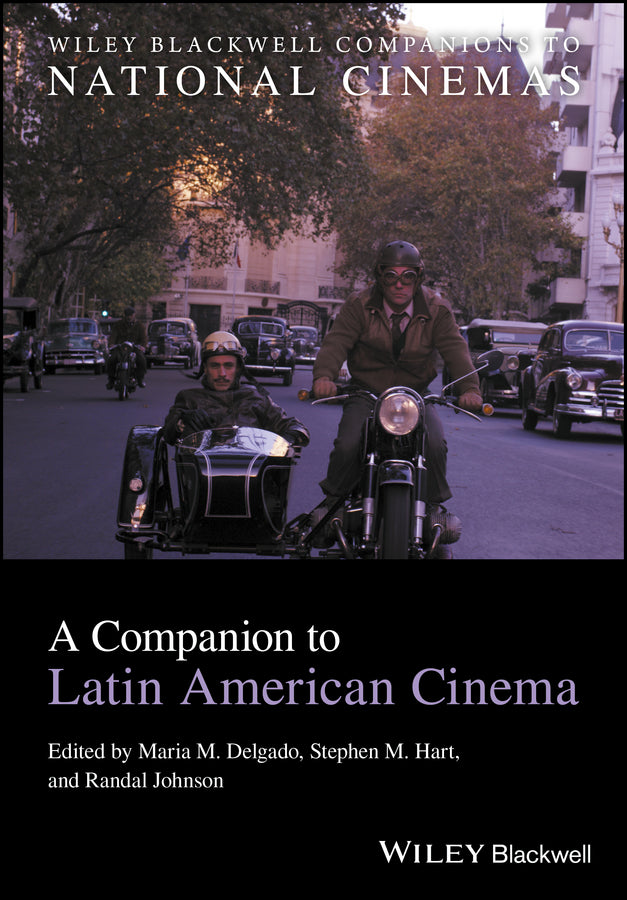
A Companion to Latin American Cinema
“This superb collection sheds important light on the recent shifts in understanding of the geopolitical and commercial (re)positioning of Latin American cinema in the global marketplace, tracking the vibrant and fast-paced circuits of commerce, affect and soft power with nuance and verve. The scholarship is illuminating, often compelling, as it engages with stardom, performance, nostalgia, memory and politics and mobilizes discussion on the importance of the digital turn and the ineluctable pull between the local and the global whilst also taking stock of new directions both in theory and practice. A discrete section of interviews with directors is a most welcome inclusion in what is an indispensable book for those who want an informed analysis of the contemporary landscape in Latin American cinema.”
Dr Sarah Wright, Reader in Hispanic Studies, Royal Holloway, University of London
"A richly informed and probing analysis of one of the world's most dynamic film-making regions. Indispensable”
Demetrios Matheou, film critic and author of The Faber Book of New South American Cinema
An essential and highly readable study that investigates cinematic languages of Latin America’s vibrant film scene to provide a curated collection on resurgent methodologies of fictional storytelling and documentaries. This extremely useful resource maps the current state of production, distribution, and exhibition, and the political trajectories of the cinema of Latin America. Particularly invaluable is the inclusion of interviews with key players from the moving image sector of that region.
Nico Marzano,
Maria M. Delgado (Edited by), Stephen M. Hart (Edited by), Randal Johnson (Edited by)
9781118552889, Wiley
Hardback, published 21 April 2017
560 pages
24.6 x 17.5 x 2.5 cm, 1.111 kg
A Companion to Latin American Cinema offers a wide-ranging collection of newly commissioned essays and interviews that explore the ways in which Latin American cinema has established itself on the international film scene in the twenty-first century.
Notes on Contributors viii Acknowledgments xiv Introduction 1 Part I The Film Industry: Funding, Production, Distribution, Exhibition 19 1 Television and the Transformation of the Star System in Brazil 21 2 Stardom in Spanish America 36 3 Audiovisual Sector Incentives and Public Policy in Selected Latin American Countries 54 4 Film, the Audiovisual, and New Technology in Latin America: Public Policy in the Context of Digital Convergence 71 5 Film Funding Opportunities for Latin American Filmmakers: A Case for Further North–South Collaboration in Training and Film Festival Initiatives 85 6 The Film Festival Circuit: Identity Transactions in a Translational Economy 99 Part II Continental Currents: Documenting and Representing Identities 115 7 Latin American Documentary: A Political Trajectory 117 8 The Politics of Landscape 133 9 From Postmodernity to Post‐Identity: Latin American Film after the Great Divide 150 10 Indigenous Filmmaking in Latin America 167 11 What Is the Child for Latin American Cinema? Spectatorship, Mobility, and Authenticity in Pedro Gonzalez Rubio’s Alamar (2009) 187 12 Affect, Nostalgia, and Modernization: Popular Music in Twenty‐First‐Century Mexican and Chilean Cinema 201 Part III National Cinemas: Initiatives, Movements, and Challenges 217 13 Memories of Cuban Cinema, 1959–2015 219 14 Politics, Memory and Fiction(s) in Contemporary Argentine Cinema: The Kirchnerist Years 238 15 Neoliberalism and the Politics of Affect and Self‐Authorship in Contemporary Chilean Cinema 269 16 Popular Cinema/Quality Television: A New Paradigm for the Mexican Mediascape 285 17 Alumbramento, Friendship, and Failure: New Filmmaking in Brazil in the Twenty‐First Century 294 18 The Reinvention of Colombian Cinema 307 19 Rendering the Invisible Visible: Reflections on the Costa Rican Film Industry in the Twenty‐First Century 325 Part IV New Configurations: Travel, Technology, Television 341 20 The Horizontal Spread of a Vertical Malady: Cosmopolitanism and History in Pernambuco’s Recent Cinematic Sensation 343 21 Artists’ Cinema in Brazil 357 22 Brazilian Film and Television in Times of Intermedia Diversification 375 23 A Mexican in Hollywood or Hollywood in Mexico? Globalized Culture and Alfonso Cuaron’s Films 392 24 Latin American Cinema’s Trojan Horse 408 Part V The Interview Corner: Pragmatics and Praxis 431 25 “Finding the right balance”: An Interview with Martin Rejtman 433 26 “Escaping from an ordinary world into a more epic one”: An Interview with Alvaro Brechner 446 27 “The capacity to create mystery”: An Interview with Pablo Larrain 459 28 “A story might be similar from different places, but the language of representation is not”: An Interview with Jeannette Paillan 473 29 “Meeting points”: An Interview with Mariana Rondon and Marite Ugas 487 30 “Film is about connecting”: An Interview with Diego Luna 499 31 “The bridge between the others and us”: An Interview with Alejandro Gonzalez Inarritu 509 Index 519
Maria M. Delgado, Stephen M. Hart, and Randal Johnson
Randal Johnson
Leah Kemp
Steve Solot
Roque Gonzalez Translated by Franny Brogan and Randal Johnson
Tamara L. Falicov
Mar Diestro‐Dopido
Michael Chanan
Jens Andermann
Geoffrey Kantaris
Charlotte Gleghorn
Deborah Martin
Duncan Wheeler
Joel del Rio and Enrique Colina Translated by Stephen M. Hart
Maria M. Delgado and Cecilia Sosa
Joanna Page
Paul Julian Smith
Denilson Lopes Translated by Stephen M. Hart
Juana Suarez
Liz Harvey
Lucia Nagib
Andre Parente Translated by Randal Johnson
Esther Hamburger
German Martinez Martinez
Stephen M. Hart and Owen Williams
Maria M. Delgado
Maria M. Delgado
Maria M. Delgado
Charlotte Gleghorn
Maria M. Delgado
Maria M. Delgado
Damon Wise
Subject Areas: Society & culture: general [JF]