Freshly Printed - allow 7 days lead
Couldn't load pickup availability
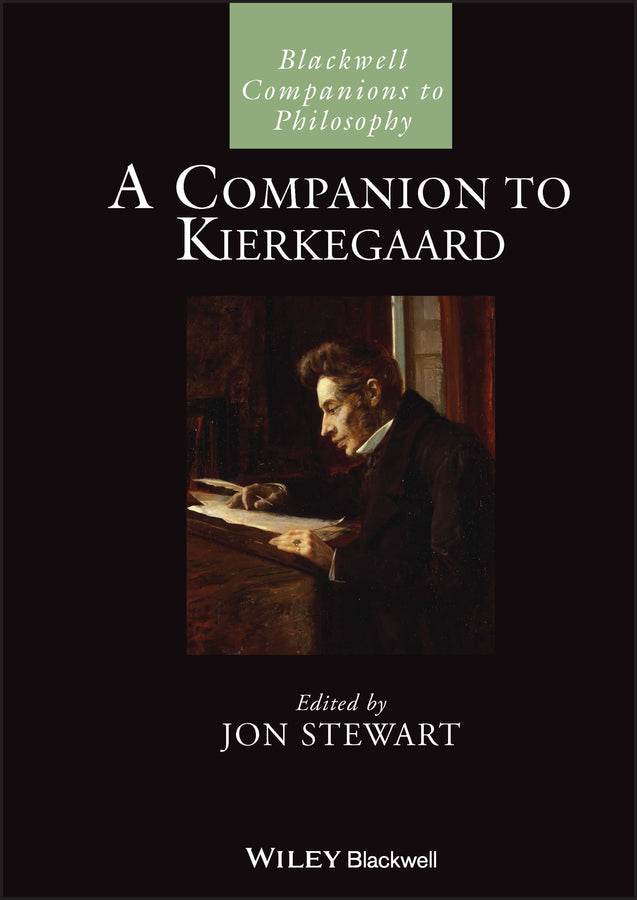
A Companion to Kierkegaard
Jon Stewart (Edited by), J Stewart (Author)
9781118783818, Wiley
Hardback, published 11 December 2015
544 pages
25.2 x 17.5 x 3.1 cm, 0.957 kg
A COMPANION TO KIERKEGAARD “‘Companions’ to important thinkers help readers focus on the main drift of their texts with the help of a dig into their origin and some account of their reception. This one digs deeper, and over a wider terrain, than most. But it does more. Besides guiding us to the staples of theology and philosophy in Kierkegaard’s background, it also looks forward to a future, as if Kierkegaard, too, might be taken by the arm and told that here was something that should interest him (about politics, social life, psychology, education, literary theory, deconstruction, theatre). It is as much a sign of the extraordinary richness of Kierkegaard’s literary palette as of the now wide currency of his thought that its elements can become topics in their own right, with Kierkegaard their inspiration. Jon Stewart and his authors are to be congratulated for bringing this unique thinker into our living presence on such a scale and with so many things to talk about.” Alastair Hannay, Professor Emeritus, University of Oslo Born in Copenhagen in 1813, Søren Kierkegaard produced a remarkable amount of work during his fairly short life. When he died in 1855 he left behind a complex and interdisciplinary legacy that continues to spark academic debate. Edited by one of the world’s leading Kierkegaard scholars, A Companion to Kierkegaard provides the most comprehensive single-volume overview of Kierkegaard studies currently available. Featuring contributions from an international array of scholars, the collection covers all the major topics within the broad field of Kierkegaard research, including philosophy, theology, aesthetics, art, literary theory, social sciences, and politics. Kierkegaard’s contribution to each of these disciplines is illustrated through examination of the sources he drew upon, the reception of his ideas, and the unique conceptual insights he brought to each topic. A Companion to Kierkegaard demystifies the complex field of Kierkegaard studies providing the ideal entry-point into his writing for readers at all levels. This collection will be an essential tool for students and scholars from across the disciplines who are interested in learning more about this important and influential thinker.
Notes on Contributors ix Acknowledgments xiii Chronology of Kierkegaard’s Works xiv List of Abbreviations xviii Editor’s Introduction: Kierkegaard and the Rich Field of Kierkegaard Studies 1 Part I Philosophy 19 A. Sources 21 1 A Shimmering Socrates: Philosophy and Poetry in Kierkegaard’s Platonic Authorship 23 2 Kierkegaard’s Use of German Philosophy: Leibniz to Fichte 36 3 Kierkegaard’s View of Hegel, His Followers and Critics 50 4 Kierkegaard’s Relations to Danish Philosophy of the Golden Age 66 B. Reception 81 5 Kierkegaard and Existentialism: From Anxiety to Autonomy 83 6 Postmodernism and Deconstruction: Paradox, Sacrifice, and the Future of Writing 96 C. Concepts and Contributions 111 7 Kierkegaard’s Views on normative Ethics, Moral Agency, and Metaethics 113 8 Kierkegaard’s Skepticism 126 Part II Theology and Religious Studies 139 A. Sources 141 9 Kierkegaard and Biblical Studies: A Critical Response to nineteenth‐Century Hermeneutics 143 10 Grace and Rigor in Kierkegaard’s Reception of the Church Fathers 155 11 Kierkegaard’s Mystical and Spiritual Sources: Meister Eckhart to tersteegen 167 12 Kierkegaard’s Appropriation and Critique of Luther and Lutheranism 180 13 Shapers of Kierkegaard’s Danish Church: Mynster, Grundtvig, Martensen 193 B. Reception 207 14 From Barth to tillich: Kierkegaard and the Dialectical theologians 209 15 other Lutheran theologians Responding Contextually to Kierkegaard 223 16 Catholicism: Finding Inspiration and Provocation in Kierkegaard 237 C. Concepts and Contributions 251 17 Kierkegaard as Existentialist Dogmatician: Kierkegaard on Systematic theology, Doctrine, and Dogmatics 253 18 Biblical Variations: Kierkegaard’s Rewritten “Life of Jesus” 269 19 Rethinking Religion Existentially: New Approaches to Classical Problems of Religious Philosophy in Kierkegaard 281 Part III Aesthetics, the Arts, and Literary Theory 295 A. Sources 297 20 Kierkegaard’s Use of German Literature 299 21 Kierkegaard and the Aesthetics of the Danish Golden Age 311 B. Reception 325 22 Literature and (Anti‐)Humanism 327 23 Kierkegaard’s Influence on Literary Criticism and Theory: Irony, Repetition, Silence 341 C. Concepts and Contributions 353 24 Existence and the Aesthetic Forms 355 25 Kierkegaard’s Theatrical Aesthetic from Repetition to Imitation 367 Part IV Social Sciences and Politics 381 A. Sources 383 26 Politics, Society, and Theology in Golden Age Denmark: Key Themes and Figures 385 27 Reflections on Late Modernity: Kierkegaard in the “Present Age” 399 B. Reception 413 28 Between Anthropology, Sociology, and Psychology: The Insider/Outsider Self 415 29 Kierkegaard’s Social‐Political Posterity: A Still Unnavigated Maze 435 C. Concepts and Contributions 451 30 Kierkegaard’s Conception of Psychology: How to Understand It and Why It Still Matters 453 31 Kierkegaard and the Limits of Philosophical Anthropology 468 32 Prolegomena for thinking of Kierkegaard as a Social and Political Philosopher 480 33 Making Kierkegaard Relevant to Education today 490
Jacob Howland
Roe Fremstedal
Jon Stewart
Carl Henrik Koch
K. Brian Söderquist
Marius Timmann Mjaaland
Roe Fremstedal
Darío González
Lee C. Barrett
Jack Mulder, Jr.
Peter Šajda
Lee C. Barrett
Curtis L. Thompson
Heiko Schulz
Curtis L. Thompson
Christopher B. Barnett and Peter Šajda
David R. Law
Iben Damgaard
István Czakó
Joachim Grage
Nathaniel Kramer
Poul Houe
J.D. Mininger
Darío González
Timothy Stock
Stephen Backhouse
Daniel Conway
Simon D. Podmore
Leo Stan
René Rosfort
Jamie Turnbull
J. Michael Tilley
Timothy Hall Index 502
Subject Areas: Philosophy [HP]