Freshly Printed - allow 7 days lead
Couldn't load pickup availability
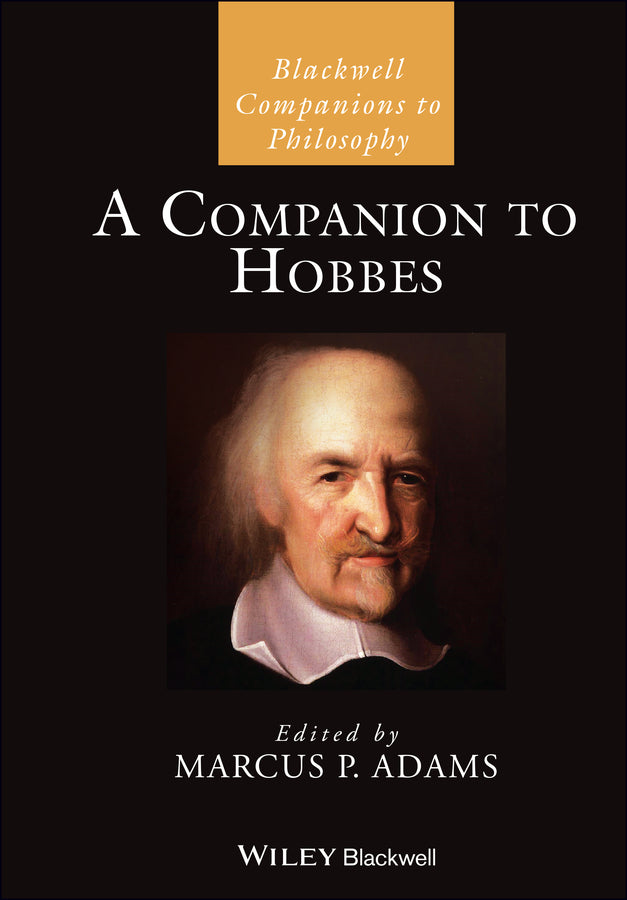
A Companion to Hobbes
Marcus P. Adams (Edited by)
9781119634997, Wiley
Hardback, published 18 October 2021
544 pages
1 x 1 x 1 cm, 0.454 kg
"Hobbes has had many companions, and this collection is a welcome addition to their ranks. [...] the volume makes a significant contribution to the literature on Hobbes [...] shows that the supply of great scholarship in Hobbes studies has not run dry."— Hobbes Studies
Offers comprehensive treatment of Thomas Hobbes’s thought, providing readers with different ways of understanding Hobbes as a systematic philosopher As one of the founders of modern political philosophy, Thomas Hobbes is best known for his ideas regarding the nature of legitimate government and the necessity of society submitting to the absolute authority of sovereign power. Yet Hobbes produced a wide range of writings, from translations of texts by Homer and Thucydides, to interpretations of Biblical books, to works devoted to geometry, optics, morality, and religion. Hobbes viewed himself as presenting a unified method for theoretical and practical science—an interconnected system of philosophy that provides many entry points into his thought. A Companion to Hobbes is an expertly curated collection of essays offering close textual engagement with the thought of Thomas Hobbes in his major works while probing his ideas regarding natural philosophy, mathematics, human nature, civil philosophy, religion, and more. The Companion discusses the ways in which scholars have tried to understand the unity and diversity of Hobbes’s philosophical system and examines the reception of the different parts of Hobbes’s philosophy by thinkers such as René Descartes, Margaret Cavendish, David Hume, and Immanuel Kant. Presenting a diversity of fresh perspectives by both emerging and established scholars, this volume: Part of the acclaimed Blackwell Companions to Philosophy series, A Companion to Hobbes is an invaluable resource for scholars and advanced students of Early modern thought, particularly those from disciplines such as History of Philosophy, Political Philosophy, Intellectual History, History of Politics, Political Theory, and English.
Notes on Contributors viii Introduction: The Presentation and Structure of Thomas Hobbes's Philosophy 1 Abbreviations for Citations to Hobbes's Works 20 Part I First Philosophy, Mathematics, and Natural Philosophy 23 1 Hobbes's Unified Method for Scientia 25 2 The Stoic Roots of Hobbes's Natural Philosophy and First Philosophy 45 3 Hobbesian Mathematics and the Dispute with Wallis 57 4 Explanations in Hobbes's Optics and Natural Philosophy 75 Part II Human Nature and Morality 91 5 "A Most Useful Economy": Hobbes on Linguistic Meaning and Understanding 93 6 Hobbes’s Theory of the Good: Felicity by Anticipatory Pleasure 109 7 In search of "A Constant Civill Amity": Hobbes on Friendship and Sociability 125 8 Hobbes on Power and Gender Relations 139 9 The State of Nature as a Continuum Concept 156 10 Hobbes's Minimalist Moral Theory 171 Part III Civil Philosophy 185 11 Hobbesian Persons and Representation 187 12 Hobbes's Account of Authorizing a Sovereign 203 13 The Strength and Significance of Subjects' Rights in Leviathan 221 14 Hobbes on Sovereignty and Its Strains 236 15 Hobbes on International Ethics 252 Part IV Religion 269 16 Against Philosophical Darkness: A Political Conception of Enlightenment 271 17 Hobbes on Submission to God 287 18 Thomas Hobbes and the Christian Commonwealth 303 19 Hobbes and Toleration 318 20 Hobbes, Rome's Enemy 332 21 Hobbes and the Papal Monarchy 348 Part V Controversies and Reception 365 22 Body and Space in Hobbes and Descartes 367 23 Hobbes's Mechanical Philosophy and Its English Critics 381 24 Cudworth as a Critic of Hobbes 398 25 Cavendish and Hobbes on Causation 413 26 Striving, Happiness, and the Good: Spinoza as Follower and Critic of Hobbes 431 27 Hobbes and Astell on War and Peace 448 28 Hobbes and Hume on Human Nature: "Much of a Dispute of Words?" 463 29 He Shows "Genius" and Is "More Useful than Pufendorf": Kant's Reception of Hobbes 478 30 Catharine Macaulay and the Reception of Hobbes During the Eighteenth Century 492 Index 505
Marcus P. Adams
Helen Hattab
Geoffrey Gorham
Douglas Jesseph
Marcus P. Adams
R. W. McIntyre
Arash Abizadeh
Gabriella Slomp
Sandra Leonie Field
S. A. Lloyd
Michael J. Green
Mónica Brito Vieira
Rosamond Rhodes
Eleanor Curran
Tom Sorell
Johan Olsthoorn
Luc Foisneau
Michael Byron
Jeffrey Collins
Johann Sommerville
Franck Lessay
Patricia Springborg
Edward Slowik
John Henry
Stewart Duncan
Marcy P. Lascano
Justin Steinberg
Jacqueline Broad
Alexandra Chadwick
Howard Williams
Karen Green
Subject Areas: Philosophy [HP]