Freshly Printed - allow 7 days lead
Couldn't load pickup availability
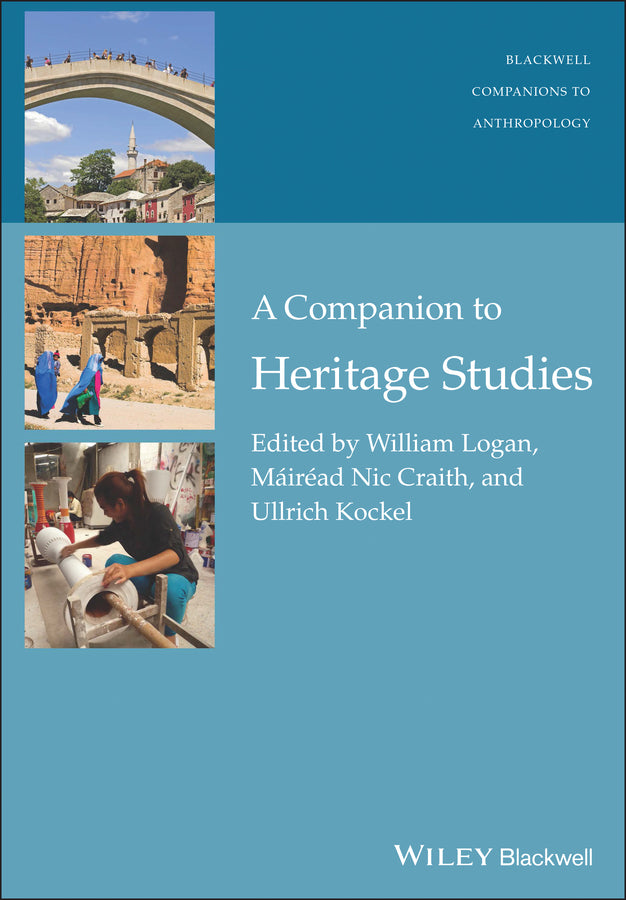
A Companion to Heritage Studies
"A gateway to heritage studies for students and scholars alike. Global in outlook, interdisciplinary in approach, the volume offers an excellent introduction to such salient topics as tangible, intangible, and digital heritage, emotion and economics, tourism and destruction, conflict and post-conflict heritage, museums and landscapes, education and law, memory and sustainability, and nationalism and cosmopolitanism." "Interdisciplinary and international in scope, the Companion to Heritage Studies succeeds in bringing together critical and practical, historicizing and future-oriented scholarship on what has become an all pervasive global interest and industry. This volume provides a source book for the specialist as well as a much needed resource for scholars and practitioners working in settings ranging from universities, to heritage sites, museums, diplomatic missions and local councils." “A vast and complete overview of the contemporary challenges of heritage preservation and management. This is an important book for practitioners, planners and policy makers. The Companion fills a gap and helps address many of the uncomfortable questions heritage preservation is facing today.”
Valdimar Tr. Hafstein, University of Iceland
Regina F. Bendix, Göttingen University, Germany
Francesco Bandarin, Special Advisor to UNESCO for Heritage and University IUAV of Venice
William Logan (Edited by), Máiréad Nic Craith (Edited by), Ullrich Kockel (Edited by)
9781118486665, Wiley
Hardback, published 13 October 2015
624 pages
24.6 x 17.5 x 3.3 cm, 1.052 kg
A Companion to Heritage Studies BLACKWELL COMPANIONS TO ANTHROPOLOGY A Companion to Heritage Studies “This Companion provides a gateway to heritage studies for students and scholars alike. Taken together, the essays testify to how exciting and dynamic this field has become.” “Interdisciplinary and international in scope, A Companion to Heritage Studies succeeds in bringing together critical and practical, historicizing and future-oriented scholarship on what has become an all-pervasive global interest and industry, passion and resource.” “A vast and complete overview of the contemporary challenges of heritage preservation and management. This is an important book for practitioners, planners, and policy makers. The Companion fills a gap and helps address many of the uncomfortable questions heritage preservation is facing today.” A Companion to Heritage Studies is a comprehensive, state-of-the-art survey of the interdisciplinary study of cultural heritage. Featuring a substantial framework-setting essay by the editors, and contributions from an international array of scholars, including some with extensive experience in heritage practice through UNESCO, the World Heritage Centre, ICOMOS and national heritage systems, this Companion offers a cutting-edge guide to this emergent and increasingly important field that is global in scope, cross-cultural in focus, and critical in approach. The selected essays have been innovatively organized into three sections on the expansion, use and abuse, and the recasting of heritage. The Companion covers all of the key themes in research, including old and new outlooks on cultural heritage and its management, heritage as a form of cultural politics, the emergence of critical heritage studies, the role of heritage in times of rapid change and conflict, heritage in environmental protection, the rise of intangible heritage, museums and digital heritage, World Heritage and tourism, and heritage ethics and human rights. A Companion to Heritage Studies will be an invaluable resource for students and scholars of anthropology, archeology, and cultural studies, as well as anyone interested in better understanding the historical, social, and political significance of heritage.
Valdimar Tr. Hafstein, University of Iceland
Regina F. Bendix, Göttingen University, Germany
Francesco Bandarin, Special Advisor to UNESCO for Heritage and Professor, University Iuav of Venice
List of Figures and Tables x Notes on Contributors xiii Acknowledgements xix List of Abbreviations xx Framework 1 The New Heritage Studies: Origins and Evolution, Problems and Prospects 1 Part I Expanding Heritage 27 2 Heritage Places: Evolving Conceptions and Changing Forms 29 3 From Folklore to Intangible Heritage 41 4 Cultural Heritage and Intellectual Property: Convergence, Divergence, and Interface 55 5 Intangible Heritage and Embodiment: Japan’s Influence on Global Heritage Discourse 69 6 The Politics of Heritage in the Land of Food and Wine 87 7 (Re)visioning the Ma’ohi Landscape of Marae Taputapuatea, French Polynesia: World Heritage and Indigenous Knowledge Systems in the Pacific Islands 101 8 The Kingdom of Death as a Heritage Site: Making Sense of Auschwitz 115 9 The Memory of the World and its Hidden Facets 133 10 African Indigenous Heritage in Colonial and Postcolonial Museums: The Case of the Batwa of Africa’s Great Lakes Region 146 Part II Using and Abusing Heritage 161 11 Valuing the Past, or, Untangling the Social, Political, and Economic Importance of Cultural Heritage Sites 163 12 Cultural Heritage under the Gaze of International Tourism Marketing Campaigns 176 13 Heritagescaping and the Aesthetics of Refuge: Challenges to Urban Sustainability 189 14 Cultural Heritage as a Strategy for Social Needs and Community Identity 203 15 Heritage in the Digital Age 215 16 World Heritage and National Hegemony: The Discursive Formation of Chinese Political Authority 229 17 War Museums and Memory Wars in Contemporary Poland 243 18 Heritage in an Expanded Field: Reconstructing Bridge‐ness in Mostar 254 19 Heritage Under Fire: Lessons from Iraq for Cultural Property Protection 268 20 The Intentional Destruction of Heritage: Bamiyan and Timbuktu 280 21 Heritage and the Politics of Cultural Obliteration: The Case of the Andes 295 Part III Recasting Heritage 307 22 The Economic Feasibility of Heritage Preservation 309 23 UNESCO and Cultural Heritage: Unexpected Consequences 322 24 The Limits of Heritage: Corporate Interests and Cultural Rights on Resource Frontiers 337 25 Indigenous Peoples’ Rights and the World Heritage Convention 355 26 UNESCO, the World Heritage Convention, and Africa: The Practice and the Practitioners 373 27 World Heritage Sites in Africa: What Are the Benefits of Nomination and Inscription? 392 28 Heritage in the “Asian Century”: Responding to Geopolitical Change 410 29 (Re‐)Building Heritage: Integrating Tangible and Intangible 426 30 The Elephant in the Room: Heritage, Affect, and Emotion 443 31 Cross‐Cultural Encounters and “Difficult Heritage” on the Thai–Burma Railway: An Ethics of Cosmopolitanism rather than Practices of Exclusion 461 32 Heritage and Cosmopolitanism 479 33 “Putting Broken Pieces Back Together”: Reconciliation, Justice, and Heritage in Post‐Conflict Situations 491 34 Achieving Dialogue through Transnational World Heritage Nomination: The Case of the Silk Roads 507 35 World Heritage: Alternative Futures 522 36 Challenges for International Cultural Heritage Law 541 37 The New Heritage Studies and Education, Training, and Capacity‐Building 557 Index 574
William Logan, Ullrich Kockel, and Máiréad Nic Craith
Neil A. Silberman
Kristin Kuutma
Folarin Shyllon
Natsuko Akagawa
Marion Demossier
Anita Smith
Jonathan Webber
Anca Claudia Prodan
Maurice Mugabowagahunde
Brenda Trofanenko
Helaine Silverman and Richard W. Hallett
Tim Winter
Keir Reeves and Gertjan Plets
Maria Economou
Haiming Yan
Julie Fedor
Andrea Connor
Benjamin Isakhan
Christian Manhart
O. Hugo Benavides
Ron van Oers
Christina Cameron
Rosemary J. Coombe and Melissa F. Baird
Stefan Disko
George Okello Abungu
Webber Ndoro
Zeynep Aygen and William Logan
Máiréad Nic Craith and Ullrich Kockel
Laurajane Smith and Gary Campbell
Andrea Witcomb
Lynn Meskell
Patrick Daly and Benjamin Chan
Ona Vileikis
Britta Rudolff and Kristal Buckley
Ana Filipa Vrdoljak
William Logan and Gamini Wijesuriya
Subject Areas: Archaeology [HD]