Freshly Printed - allow 7 days lead
Couldn't load pickup availability
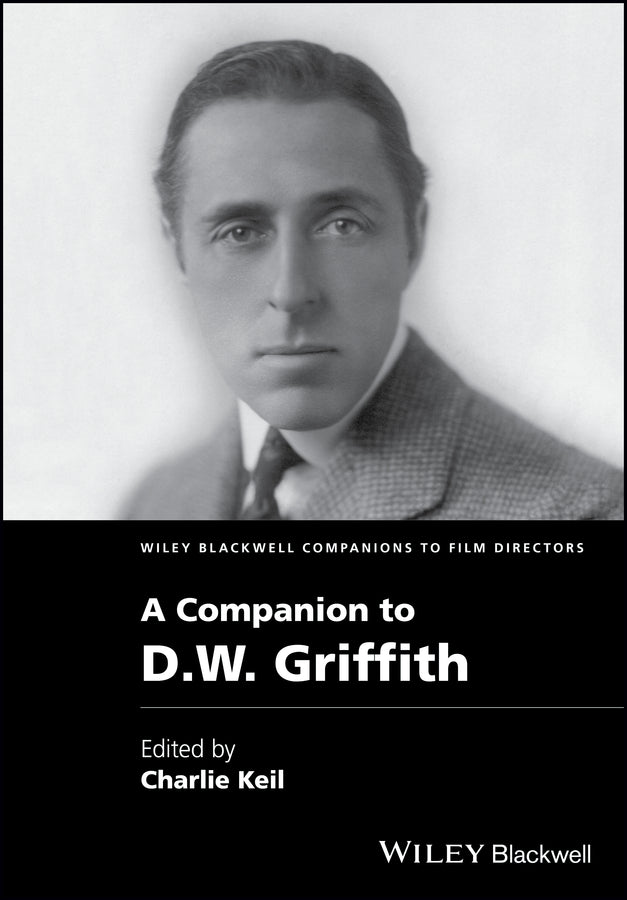
A Companion to D. W. Griffith
Charles Keil (Edited by)
9781118341254, Wiley
Hardback, published 26 January 2018
624 pages
24.6 x 17 x 3.3 cm, 1.111 kg
The most comprehensive volume on one of the most controversial directors in American film history A Companion to D.W. Griffith offers an exhaustive look at the first acknowledged auteur of the cinema and provides an authoritative account of the director’s life, work, and lasting filmic legacy. The text explores how Griffith’s style and status advanced along with cinema’s own development during the years when narrative became the dominant mode, when the short gave way to the feature, and when film became the pre-eminent form of mass entertainment. Griffith was at the centre of each of these changes: though a contested figure, he remains vital to any understanding of how cinema moved from nickelodeon fixture to a national pastime, playing a significant role in the cultural ethos of America. With the renewed interest in Griffith’s contributions to the film industry, A Companion to D.W. Griffith offers a scholarly look at a career that spanned more than 25 years. The editor, a leading scholar on D.W. Griffith, and the expert contributors collectively offer a unique account of one of the monumental figures in film studies.
Contributors viii Preface ix Introduction 1 Charlie Keil Part One Griffith Redux 1 Disciplinary Descent: Film Studies, Families, and the Origins of Narrative Cinema 17 2 Griffith’s Moral Profile 34 3 “The Beauty of Moving Wind in the Trees”: Cinematic Presence and the Films of D.W. Griffith 74 Part Two Style in the Biograph Era 4 D.W. Griffith and the Emergence of Crosscutting 107 5 D.W. Griffith and the Primal Scene 137 6 Griffith’s Biograph Shorts: Electric Power and Film Style, from East to West 150 Part Three Imagery and Intermediality 7 Deep Theatrical Roots: Griffith and the Theater 175 8 Notes on Floral Symbolism, Allegory, and Intermediality in the Films of D.W. Griffith 191 9 Living Portraits: Signs of (the) Time in D.W. Griffith 216 Part Four Gender and Progressivism 10 Griffith’s Body Language and Film Narration: “The Voluptuary” Versus “the Spirituelle” 245 11 Cross-Dressing in Griffith’s Biograph Films: Humor, Heroics, and Edna “Billy” Foster’s Good Bad Boys 284 12 Space, Gender, Oversight, and Social Change: Progressivism and the Films of D.W. Griffith, 1909–1916 309 13 Progressive Pastoral: Social Justice Reforms and Biograph Films, 1908–1911 330 Part Five Revisiting Failed Features 14 Gendering Ministry and Reform: Griffith and the Plight of Protestant Uplift 361 15 “Squalid Without Being Tragic”: Griffith’s “Isn’t Life Wonderful” 385 16 Faust at Famous Players 423 17 Griffith in a Minor Key: Early Art Cinema Looking Backward 440 Part Six Reception at Home and Abroad 18 “Damage Unwittingly Done”: D.W. Griffith and the Re-Birth of the Ku Klux Klan 463 19 “History by Lightning”: D.W. Griffith in South Africa 486 20 Blossoms Breaking at the Dawn of Cinephilia: The Reception of D.W. Griffith in France 510 21 The legacy of Intolerance 533 Index
Paolo Cherchi Usai
Jennifer M. Bean
Ben Singer
Daniel Fairfax
André Gaudreault and Philippe Gauthier
Tom Gunning
Charles O’Brien
David Mayer
Jan Olsson
Joyce E. Jesionowski
Maggie Hennefeld
Laura Horak
Moya Luckett
Grant Wiedenfeld
Anne Morey
Russell Merritt
Andrew Nelson
Kaveh Askari
Tom Rice
Nicole Devarenne
Annie Fee
Paul McEwan
Subject Areas: Society & culture: general [JF]