Freshly Printed - allow 7 days lead
Couldn't load pickup availability
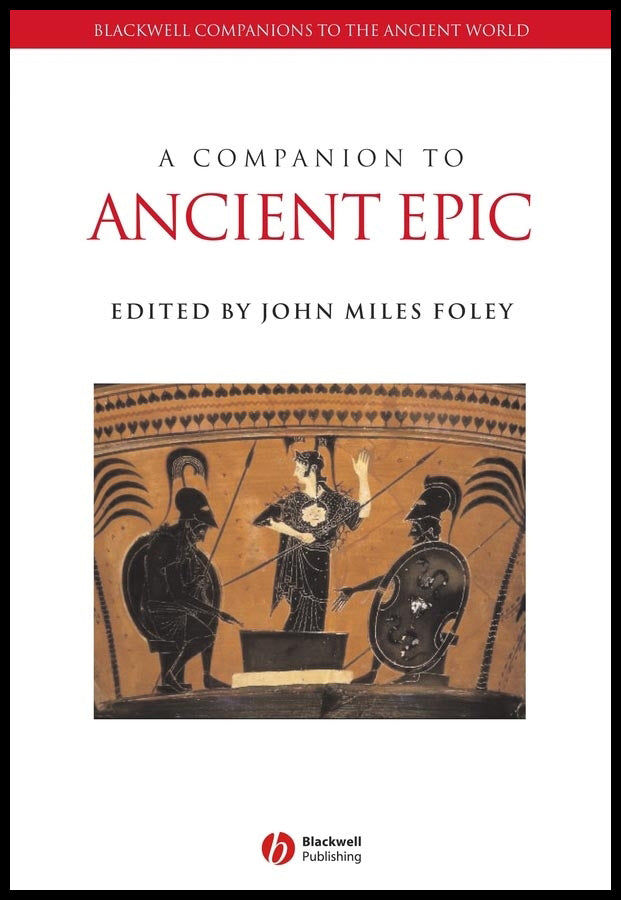
A Companion to Ancient Epic
John Miles Foley (Edited by)
9781405105248, Wiley
Hardback, published 26 July 2005
704 pages
25.3 x 17.9 x 4.2 cm, 1.315 kg
"For those who are interested in Greek and Roman epic, the book is a treasure-house of splendid variety.... The editor and the publisher both deserve praise for a very fine volume." (Journal of the Royal Asiatic Society) "Blackwell's Companion to Ancient Epic does just what the title suggests: it accompanies readers on journeys of exploration in this huge (in every sense) field. Just as importantly, the Companion will show new readers why they might want to immerse themselves in these poems.... The many highlights in this Companion demonstrate the value of asking scholars to write for non-specialists. That endeavor provides a stimulus for new levels of focus and clarity; even ideas and materials that may be familiar become fresh again when they are presented in such succinct distillations." (Bryn Mawr Classical Review)
A Companion to Ancient Epic presents for the first time a comprehensive, up-to-date overview of ancient Near Eastern, Greek and Roman epic. It offers a multi-disciplinary discussion of both longstanding ideas and newer perspectives.
List of Illustrations ix Notes on Contributors xi Abbreviated Source Editions and Lexica xvii Maps xx Introduction: A Prolegomenon to Ancient Greek Government 1 PART I Greek Government in History 7 1 The Rise of State Action in the Archaic Age 9 2 The Classical Greek Polis and Its Government 22 3 Dynastic Courts of the Hellenistic Empires 38 4 Hellenistic Cities: The End of Greek Democracy? 54 PART II Ancient Templates and Typologies 71 5 Archaic and Classical Greek Reflections on Politics and Government: From Description to Conceptualization, Analysis, and Theory 73 6 Plato’s View on Greek Government 93 7 Aristotle 105 8 Polybios on Government, Interstate Relations, and Imperial Expansion 119 9 One-Man Government: The Greeks and Monarchy 131 10 Unlike(ly) Twins? Democracy and Oligarchy in Context 146 PART III To Rule and Be Ruled: Greek Governing Bodies 159 11 Citizenship, the Citizen Body, and its Assemblies 161 12 Officials and Office-Holding 176 13 Councils in Greek Oligarchies and Democracies 191 14 Law Courts 205 PART IV Process and Procedure 219 15 Laws and Legislation in Ancient Greece 221 16 Tyche’s Force: Lottery and Chance in Greek Government 235 17 Governmental Checks and Balances 252 18 Forms and Forums of Public Speech 267 PART V Responsibilities and Realms of Action 285 19 Public Administration 287 20 Greek Government and Education: Re-examining the eph¯ebeia 302 21 Government and Warfare 317 22 Finance and Taxes 332 23 Greek Government and the Organization of Time 349 24 The Religious Management of the polis: Oracles and Political Decision-Making 366 PART VI Space and Memory 383 25 Spaces of Government: Civic Architecture and Memory 385 26 Keeping Record, Making Public: The Epigraphy of Government 400 27 Monumental Representations of Government 417 28 State Festivals and Celebrations 432 PART VII Government Beyond the City-State 449 29 Greek Amphiktyonies: An Experiment in Transregional Governance 451 30 Polis and koinon: Federal Government in Greece 466 31 Governing Interstate Alliances 480 32 Interstate Governance: Arbitration and Peacekeeping 497 Epilogue: The Legacy of Greek Government – Something That Has ‘‘Never Occurred Again’’? 512 Bibliography 525 Index 581
Hans Beck
Jonathan M. Hall
Barry Strauss
Rolf Strootman
Hans-Ulrich Wiemer
Kurt A. Raaflaub
Luc Brisson
Peter L.P. Simpson
Craige B. Champion
Nino Luraghi
Hartmut Leppin
Josine Blok
Alex McAuley
Robert W. Wallace
Domingo Avil´es and David C. Mirhady
Michael Gagarin
Elizabeth Kosmetatou
Pierre Fr¨ohlich
Loren J. Samons II
Frances Pownall
Lynn Kozak
John Serrati
Vincent Gabrielsen
Robert Hannah
Pierre Bonnechere
Charles W. Hedrick, Jr.
Adele C. Scafuro
Jenifer Neils
Pauline Schmitt Pantel
Peter Funke
Jeremy McInerney
Thomas Figueira and Sean R. Jensen
Sheila L. Ager
Uwe Walter
Subject Areas: Literature: history & criticism [DS]