Freshly Printed - allow 7 days lead
Couldn't load pickup availability
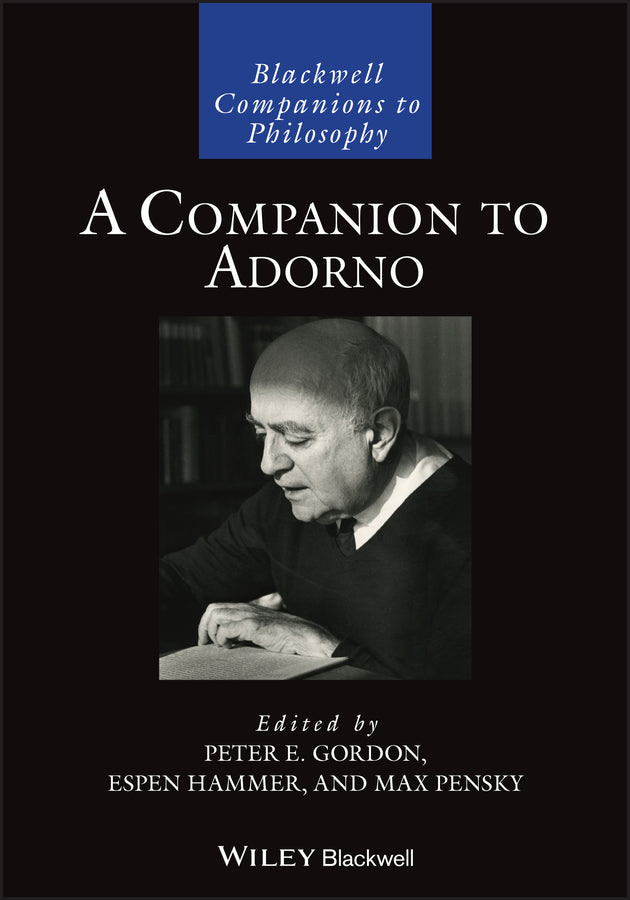
A Companion to Adorno
Peter E. Gordon (Edited by), Espen Hammer (Edited by), Max Pensky (Edited by)
9781119147015, Wiley
Paperback / softback, published 1 September 2025
688 pages
25.2 x 17.8 x 3.6 cm, 1.157 kg
“This outstanding Companion proves the usual assumption wrong that there is no possibility today to contribute something new and original to the work of Theodor W. Adorno. The three editors, all equally superb experts of his philosophy, have managed with circumspection and discretion to collect thoroughly stimulating articles that together open up a novel and fresh perspective on this central figure of critical theory. Everyone who’s keeping up with what’s going on in this tradition has to read this Companion.” “An exemplary Companion of extremely well-formed essays together covering the extraordinary range of Adorno’s philosophical, social, and aesthetic thought. Highly recommended for anyone working through the issues and relevance of critical theory today.” As one of the leading continental philosophers of the last century, and a pioneering member of the Frankfurt School, Theodor W. Adorno was the author of seminal—and at times quite radical—scholarship in aesthetics, social theory, moral philosophy, and the history of modern philosophy which concerns the contradictions of modern society in relation to human suffering and the human condition. Having made substantial contributions to critical theory which levy searching critiques of the ‘culture industry’ and the ‘identity thinking’ of modern Western society, Adorno helped establish an interdisciplinary but philosophically rigorous study of culture, and provided some of the most startling and revolutionary critiques of Western society to date. A Companion to Adorno is the largest collection of newly commissioned essays by a distinguished array of Adorno scholars, specialists, and leading interpreters ever gathered in a single volume. Part of the distinguished Blackwell Companions to Philosophy series, this important contribution to the field explores Adorno’s lasting impact on many sub-fields of philosophy from a rich variety of perspectives. Chapters in each of seven sections explore Adorno’s intellectual foundations, his critiques of culture, his views on ethics and politics, and his analyses of history and domination, and collectively asserting the contemporary importance of his social thought and broader intellectual legacy. A singular advancement in Adorno scholarship, A Companion to Adorno is an indispensable resource for Adorno specialists and researchers working in modern European philosophy, contemporary cultural criticism, social theory, German history, and aesthetics.
Axel Honneth, Jack C. Weinstein Professor of the Humanities, Columbia University
Lydia Goehr, Professor of Philosophy, Columbia University
Notes on Contributors ix Editors’ Introduction xv About the Editors xix Part I Intellectual Foundations 1 1 Adorno: A Biographical Sketch 3 2 Adorno’s Inaugural Lecture: The Actuality of Philosophy in the Age of Mass Production 21 3 Reading Kierkegaard 35 4 Guilt and Mourning: Adorno’s Debt to and Critique of Benjamin 51 5 Adorno and the Second Viennese School 67 Part II Cultural Analysis 85 6 The Culture Industry 87 7 Adorno and Horkheimer on Anti-Semitism 103 8 Adorno and Jazz 123 9 Adorno’s Democratic Modernism in America: Leaders and Educators as Political Artists 139 10 Inhuman Methods for an Inhumane World: Adorno’s Empirical Social Research, 1938–1950 153 Part III History and Domination 173 11 Adorno and Blumenberg: Nonconceptuality and the Bilderverbot 175 12 Philosophy of History 193 13 The Anthropology in Dialectic of Enlightenment 207 14 Adorno’s Reception of Weber and Lukács 221 15 Adorno’s Aesthetic Model of Social Critique 237 16 The Critique of the Enlightenment 251 Part IV Social Theory and Empirical Inquiry 271 17 “Nothing is True Except the Exaggerations:” The Legacy of The Authoritarian Personality 273 18 Exposing Antagonisms: Adorno on the Possibilities of Sociology 287 19 Adorno and Marx 303 20 Adorno’s Three Contributions to a Theory of Mass Psychology and Why They Matter 321 21 Adorno and Postwar German Society 335 Part V Aesthetics 349 22 Aesthetic Autonomy 351 23 Adorno and Literary Criticism 365 24 Adorno as a Modernist Writer 383 25 Adorno’s Aesthetic Theory 397 26 Aesthetic Theory as Social Theory 413 27 Adorno, Music, and the Ineffable 427 28 Adorno and Opera 443 Part VI Negative Dialectics 457 29 What Is Negative Dialectics?: Adorno’s Reevaluation of Hegel 459 30 Adorno’s Critique of Heidegger 473 31 Concept and Object: Adorno’s Critique of Kant 487 32 Critique and Disappointment: Negative Dialectics as Late Philosophy 503 33 Negative Dialectics and Philosophical Truth 519 34 Adorno and Scholem: The Heretical Redemption of Metaphysics 531 35 Adorno’s Concept of Metaphysical Experience 549 Part VII Ethics and Politics 565 36 After Auschwitz 567 37 Forever Resistant? Adorno and Radical Transformation of Society 583 38 Adorno’s Materialist Ethic of Love 601 39 Adorno’s Metaphysics of Moral Solidarity in the Moment of its Fall 615 Index 631
Peter E. Gordon
Roger Foster
Marcia Morgan
Alexander Stern
Sherry D. Lee
Fred Rush
Fabian Freyenhagen Copyrighted Material
Andrew Bowie
Shannon Mariotti
Charles Clavey
Martin Jay
Iain Macdonald
Pierre-François Noppen
Michael J. Thompson
Andrew Huddleston
Martin Shuster
David Jenemann
Matthias Benzer and Juljan Krause
Peter Osborne
Eli Zaretsky
Jakob Norberg
Owen Hulatt
Henry W. Pickford
Richard Eldridge
Eva Geulen
Peter Uwe Hohendahl
Michael Gallope
Richard Leppert
Terry Pinkard
Espen Hammer
J. M. Bernstein
Max Pensky
Brian O’Connor
Asaf Angermann
Peter E. Gordon
Christian Skirke
Maeve Cooke
Kathy J. Kiloh
James Gordon Finlayson
Subject Areas: Philosophy [HP]