Freshly Printed - allow 7 days lead
Couldn't load pickup availability
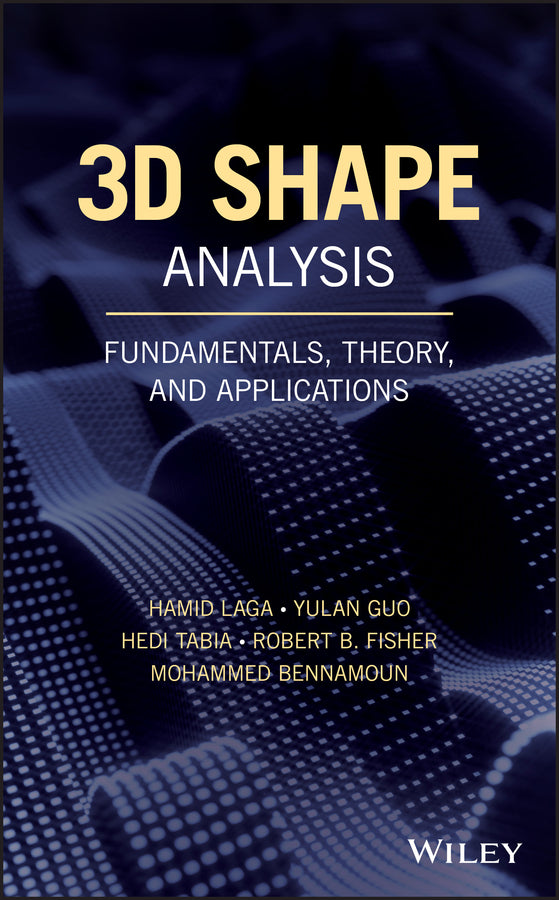
3D Shape Analysis
Fundamentals, Theory, and Applications
Hamid Laga (Author), Yulan Guo (Author), Hedi Tabia (Author), Robert B. Fisher (Author), Mohammed Bennamoun (Author)
9781119405108, Wiley
Hardback, published 1 March 2019
368 pages
23.4 x 15.8 x 2.5 cm, 0.68 kg
An in-depth description of the state-of-the-art of 3D shape analysis techniques and their applications This book discusses the different topics that come under the title of "3D shape analysis". It covers the theoretical foundations and the major solutions that have been presented in the literature. It also establishes links between solutions proposed by different communities that studied 3D shape, such as mathematics and statistics, medical imaging, computer vision, and computer graphics. The first part of 3D Shape Analysis: Fundamentals, Theory, and Applications provides a review of the background concepts such as methods for the acquisition and representation of 3D geometries, and the fundamentals of geometry and topology. It specifically covers stereo matching, structured light, and intrinsic vs. extrinsic properties of shape. Parts 2 and 3 present a range of mathematical and algorithmic tools (which are used for e.g., global descriptors, keypoint detectors, local feature descriptors, and algorithms) that are commonly used for the detection, registration, recognition, classification, and retrieval of 3D objects. Both also place strong emphasis on recent techniques motivated by the spread of commodity devices for 3D acquisition. Part 4 demonstrates the use of these techniques in a selection of 3D shape analysis applications. It covers 3D face recognition, object recognition in 3D scenes, and 3D shape retrieval. It also discusses examples of semantic applications and cross domain 3D retrieval, i.e. how to retrieve 3D models using various types of modalities, e.g. sketches and/or images. The book concludes with a summary of the main ideas and discussions of the future trends. 3D Shape Analysis: Fundamentals, Theory, and Applications is an excellent reference for graduate students, researchers, and professionals in different fields of mathematics, computer science, and engineering. It is also ideal for courses in computer vision and computer graphics, as well as for those seeking 3D industrial/commercial solutions.
Preface xv 1 Introduction 1 Part I Foundations 11 2 Basic Elements of 3D Geometry and Topology 13 3 3D Acquisition and Preprocessing 41 Part II 3D Shape Descriptors 65 4 Global Shape Descriptors 67 5 Local Shape Descriptors 93 Part III 3D Correspondence and Registration 135 6 Rigid Registration 137 7 Nonrigid Registration 161 8 Semantic Correspondences 187 Part IV Applications 207 9 Examples of 3D Semantic Applications 209 10 3D Face Recognition 223 11 Object Recognition in 3D Scenes 241 12 3D Shape Retrieval 267 13 Cross-domain Retrieval 285 14 Conclusions and Perspectives 301 References 303
Acknowledgments xvii
1.1 Motivation 1
1.2 The 3D Shape Analysis Problem 2
1.3 About This Book 5
1.4 Notation 9
2.1 Elements of Differential Geometry 13
2.2 Shape, Shape Transformations, and Deformations 30
2.3 Summary and Further Reading 38
3.1 Introduction 41
3.2 3D Acquisition 41
3.3 Preprocessing 3D Models 56
3.4 Summary and Further Reading 62
4.1 Introduction 67
4.2 Distribution-Based Descriptors 69
4.3 View-Based 3D Shape Descriptors 73
4.4 Spherical Function-Based Descriptors 77
4.5 Deep Neural Network-Based 3D Descriptors 83
4.6 Summary and Further Reading 89
5.1 Introduction 93
5.2 Challenges and Criteria 94
5.3 3D Keypoint Detection 96
5.4 Local Feature Description 113
5.5 Feature Aggregation Using Bag of Feature Techniques 126
5.6 Summary and Further Reading 131
6.1 Introduction 137
6.2 Coarse Registration 138
6.3 Fine Registration 152
6.4 Summary and Further Reading 160
7.1 Introduction 161
7.2 Problem Formulation 162
7.3 Mathematical Tools 165
7.4 Isometric Correspondence and Registration 168
7.5 Nonisometric (Elastic) Correspondence and Registration 171
7.6 Summary and Further Reading 184
8.1 Introduction 187
8.2 Mathematical Formulation 188
8.3 Graph Representation 191
8.4 Energy Functions for Semantic Labeling 194
8.5 Semantic Labeling 196
8.6 Examples 202
8.7 Summary and Further Reading 204
9.1 Introduction 209
9.2 Semantics: Shape or Status 209
9.3 Semantics: Class or Identity 212
9.4 Semantics: Behavior 216
9.5 Semantics: Position 219
9.6 Summary and Further Reading 221
10.1 Introduction 223
10.2 3D Face Recognition Tasks, Challenges and Datasets 224
10.3 3D Face Recognition Methods 228
10.4 Summary 239
11.1 Introduction 241
11.2 Surface Registration-Based Object Recognition Methods 241
11.3 Machine Learning-Based Object Recognition Methods 255
11.4 Summary and Further Reading 265
12.1 Introduction 267
12.2 Benchmarks and Evaluation Criteria 270
12.3 Similarity Measures 275
12.4 3D Shape Retrieval Algorithms 280
12.5 Summary and Further Reading 284
13.1 Introduction 285
13.2 Challenges and Datasets 287
13.3 Siamese Network for Cross-domain Retrieval 290
13.4 3D Shape-centric Deep CNN 292
13.5 Summary and Further Reading 300
Index 337
Subject Areas: Mathematics [PB]