Freshly Printed - allow 10 days lead
Couldn't load pickup availability
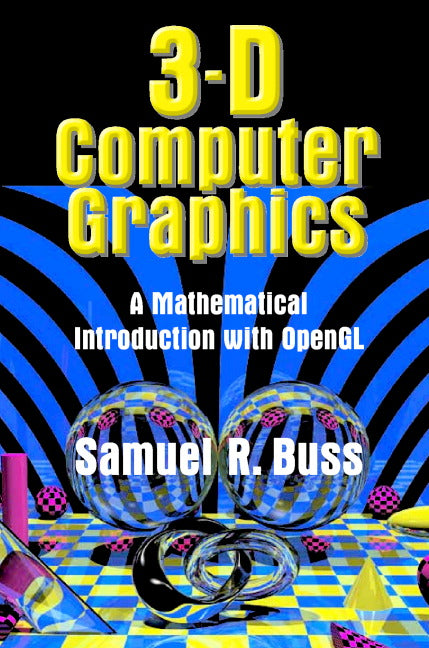
3D Computer Graphics
A Mathematical Introduction with OpenGL
Topics include transformations, lighting and shading, ray tracing, radiosity, texture mapping, colour theory, and aspects of animation.
Samuel R. Buss (Author)
9780521821032, Cambridge University Press
Hardback, published 19 May 2003
396 pages, 186 b/w illus. 8 colour illus. 150 exercises
26.2 x 18.5 x 2.6 cm, 0.868 kg
'I really did find the topic introductions a pleasure to read. The author has a nice style of writing, and he is able to encapsulate an idea well, leaving you with some confidence of a general understanding. The selection of topics is a refreshing change from standard CG books … I would highly recommend this book to someone who teaches CG and would like to modernize his or her course.' Diane Hansford, Arizona State University
This textbook, first published in 2003, emphasises the fundamentals and the mathematics underlying computer graphics. The minimal prerequisites, a basic knowledge of calculus and vectors plus some programming experience in C or C++, make the book suitable for self study or for use as an advanced undergraduate or introductory graduate text. The author gives a thorough treatment of transformations and viewing, lighting and shading models, interpolation and averaging, Bézier curves and B-splines, ray tracing and radiosity, and intersection testing with rays. Additional topics, covered in less depth, include texture mapping and colour theory. The book covers some aspects of animation, including quaternions, orientation, and inverse kinematics, and includes source code for a Ray Tracing software package. The book is intended for use along with any OpenGL programming book, but the crucial features of OpenGL are briefly covered to help readers get up to speed. Accompanying software is available freely from the book's web site.
1. Introduction
2. Transformations and viewing
3. Lighting, illumination and shading
4. Averaging and interpolation
5. Texture mapping
6. Color
7. Bezier curves
8. B-Splines
9. Ray tracing
10. Intersection testing
11. Radiosity
12. Animation and kinematics
Appendix A: mathematics background
Appendix B: RayTracing software package.
Subject Areas: Graphical & digital media applications [UG], Geometry [PBM]