Freshly Printed - allow 4 days lead
Couldn't load pickup availability
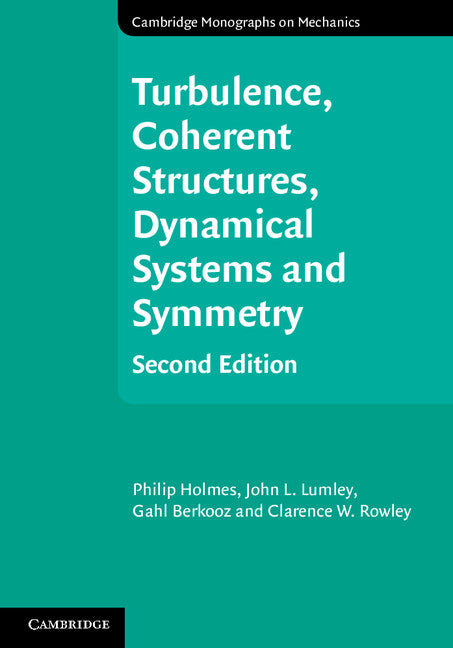
Turbulence, Coherent Structures, Dynamical Systems and Symmetry
Describes methods revealing the structures and dynamics of turbulence for engineering, physical science and mathematics researchers working in fluid dynamics.
Philip Holmes (Author), John L. Lumley (Author), Gahl Berkooz (Author), Clarence W. Rowley (Author)
9781107008250, Cambridge University Press
Hardback, published 23 February 2012
402 pages, 110 b/w illus.
25.3 x 17.9 x 2.9 cm, 0.95 kg
'The book commands an impressive bibliography of 396 references, making it an invaluable reference for any researcher who wishes to get into this area of research. The authors have done the best job possible to present this work as carefully and clearly as possible. I strongly recommend the book to everyone who wishes to master this research area, as well as everyone who wants to learn more about the proper orthogonal decomposition method. The research program detailed by the authors is a very promising approach to the problem of the coherent structures of turbulence. Active turbulence researchers, especially researchers who are mainly focused in the engineering applications of turbulence, will find this book a welcome addition to their library.' Eleftherios Gkioulekas, SIAM News
Turbulence pervades our world, from weather patterns to the air entering our lungs. This book describes methods that reveal its structures and dynamics. Building on the existence of coherent structures – recurrent patterns – in turbulent flows, it describes mathematical methods that reduce the governing (Navier–Stokes) equations to simpler forms that can be understood more easily. This second edition contains a new chapter on the balanced proper orthogonal decomposition: a method derived from control theory that is especially useful for flows equipped with sensors and actuators. It also reviews relevant work carried out since 1995. The book is ideal for engineering, physical science and mathematics researchers working in fluid dynamics and other areas in which coherent patterns emerge.
Part I. Turbulence: 1. Introduction
2. Coherent structures
3. Proper orthogonal decomposition
4. Galerkin projection
5. Balanced proper orthogonal decomposition
Part II. Dynamical Systems: 6. Qualitative theory
7. Symmetry
8. One-dimensional 'turbulence'
9. Randomly-perturbed systems
Part III. The Boundary Layer: 10. Low-dimensional models
11. Behaviour of the models
Part IV. Other Applications and Related Work: 12. Some other fluid problems
13. Review: prospects for rigor
Index.