Freshly Printed - allow 8 days lead
Couldn't load pickup availability
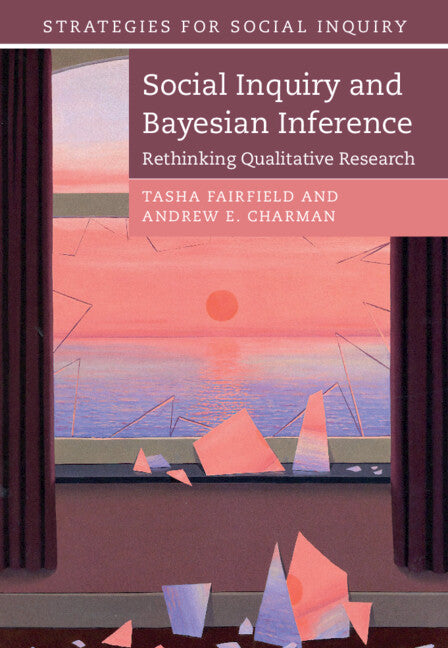
Social Inquiry and Bayesian Inference
Rethinking Qualitative Research
Provides guidance for Bayesian updating in case study, process-tracing, and comparative research, in order to refine intuition and improve inferences from qualitative evidence.
Tasha Fairfield (Author), Andrew E. Charman (Author)
9781108421645, Cambridge University Press
Hardback, published 4 August 2022
300 pages
25 x 17.3 x 4.2 cm, 1.33 kg
'This book sets out a powerful set of tools for undertaking systematic and analytically explicit qualitative inference. Fairfield and Charman provide a clear and accessible introduction to Bayesian principles and show how they can be applied to the kinds of questions and data with which qualitative social scientists routinely grapple. This volume represents an important step forward for the development and teaching of qualitative methods.' Alan Jacobs, Professor of Political Science, University of British Columbia
Fairfield and Charman provide a modern, rigorous and intuitive methodology for case-study research to help social scientists and analysts make better inferences from qualitative evidence. The book develops concrete guidelines for conducting inference to best explanation given incomplete information; no previous exposure to Bayesian analysis or specialized mathematical skills are needed. Topics covered include constructing rival hypotheses that are neither too simple nor overly complex, assessing the inferential weight of evidence, counteracting cognitive biases, selecting cases, and iterating between theory development, data collection, and analysis. Extensive worked examples apply Bayesian guidelines, showcasing both exemplars of intuitive Bayesian reasoning and departures from Bayesian principles in published case studies drawn from process-tracing, comparative, and multimethod research. Beyond improving inference and analytic transparency, an overarching goal of this book is to revalue qualitative research and place it on more equal footing with respect to quantitative and experimental traditions by illustrating that Bayesianism provides a universally applicable inferential framework.
Contents
Acknowledgements
Part I. Foundations: 1. Introduction: Bayesian reasoning for qualitative research
2. Fundamentals of Bayesian probability
Part II. Operationalizing Bayesian Reasoning in Qualitative Research: 3. Heuristic Bayesian reasoning
4. Explicit Bayesian analysis
5. Bayesian analysis with multiple cases
6. Hypotheses and priors revisited
7. Scrutinizing qualitative research
Part III. Bayesianism in Methodological Perspective: 8. Comparing logical Bayesianism to frequentism
9. A unified framework for inference
Part IV. Bayesian Implications for Research Design: 10. Iterative research
11. Test strength
12. Case selection
13. Worked examples
References
Contents
Index.
Subject Areas: Political science & theory [JPA], Social research & statistics [JHBC], Research methods: general [GPS]