Freshly Printed - allow 8 days lead
Couldn't load pickup availability
An Introduction to Fluid Mechanics
This is a modern and elegant introduction to engineering fluid mechanics enriched with numerous examples, exercises and applications.
Faith A. Morrison (Author)
9781107003538, Cambridge University Press
Hardback, published 15 April 2013
948 pages, 520 b/w illus. 40 tables 500 exercises
25.4 x 17.8 x 4.9 cm, 1.63 kg
'… being brave is what makes this book truly outstanding. The author is not afraid of throwing difficult problems and concepts to readers from the beginning … The book reads very well and it almost feels like listening to the author's lecture. It is a pleasure to find many practical advices embedded in the text … This book is a truly remarkable achievement that will significantly contribute in educating future fluid mechanists without sacrificing rigorousness and the beauty of the subject. The book will appeal to lecturers who teach introductory fluid mechanics and both undergraduate and graduate students in engineering and science majors. Practicing engineers in the related fields will also find it useful.' Dr Yong Sung Park, The Aeronautical Journal
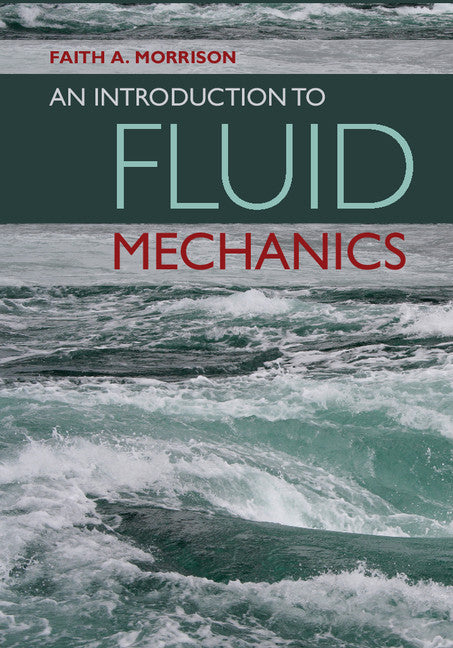
This is a modern and elegant introduction to engineering fluid mechanics enriched with numerous examples, exercises and applications. A swollen creek tumbles over rocks and through crevasses, swirling and foaming. Taffy can be stretched, reshaped and twisted in various ways. Both the water and the taffy are fluids and their motions are governed by the laws of nature. The aim of this textbook is to introduce the reader to the analysis of flows using the laws of physics and the language of mathematics. The book delves deeply into the mathematical analysis of flows; knowledge of the patterns fluids form and why they are formed, and also the stresses fluids generate and why they are generated, is essential to designing and optimising modern systems and devices. Inventions such as helicopters and lab-on-a-chip reactors would never have been designed without the insight provided by mathematical models.
Part I. Preparing to Study Flow: 1. Why study fluid mechanics?
2. How fluids behave
Part II. The Physics of Flow: 3. Modeling fluids
4. Molecular fluid stresses
5. Stress-velocity relationships
Part III. Flow Field Calculations: 6. Microscopic balance equations
7. Internal flows
8. External flows
Part IV. Advanced Flow Calculations: 9. Macroscopic balance equations
10. How fluids behave (redux)
Part V. Appendices: A. Glossary
B. Mathematics appendix
C. Supplemental mathematics appendix
D. Special topics.
Subject Areas: Mechanics of fluids [TGMF], Fluid mechanics [PHDF], Nonlinear science [PBWR], Mathematical modelling [PBWH], Optimization [PBU]